How Truly Random Numbers Are Generated: TRNG, PRNG, and CSPRNG Explained
Quick Summary
- True random number generation works by harvesting physi
- True random number generation works by harvesting physical entropy — thermal noise, atmospheric static, quantum decay — and converting those chaotic analog signals into digital bits.
- How a TRNG Works: From Physical Chaos to Digital Bits
Editorial Process
Reviewed by SectoJoy and published on May 7, 2026. This article is refreshed when product details, examples, or tool guidance change. Last updated May 15, 2026.
SectoJoy
I'm an indie hacker building iOS and web applications, with a focus on creating practical SaaS products. I specialize in AI SEO, constantly exploring how intelligent technologies can drive sustainable growth and efficiency.
True random number generation works by harvesting physical entropy — thermal noise, atmospheric static, quantum decay — and converting those chaotic analog signals into digital bits. Unlike algorithm-based generators, hardware-driven systems measure non-deterministic environmental variables to produce sequences that are mathematically unpredictable and pattern-free.
Here is how the technology works, where it fails, and how to pick the right approach for your use case.
How a TRNG Works: From Physical Chaos to Digital Bits
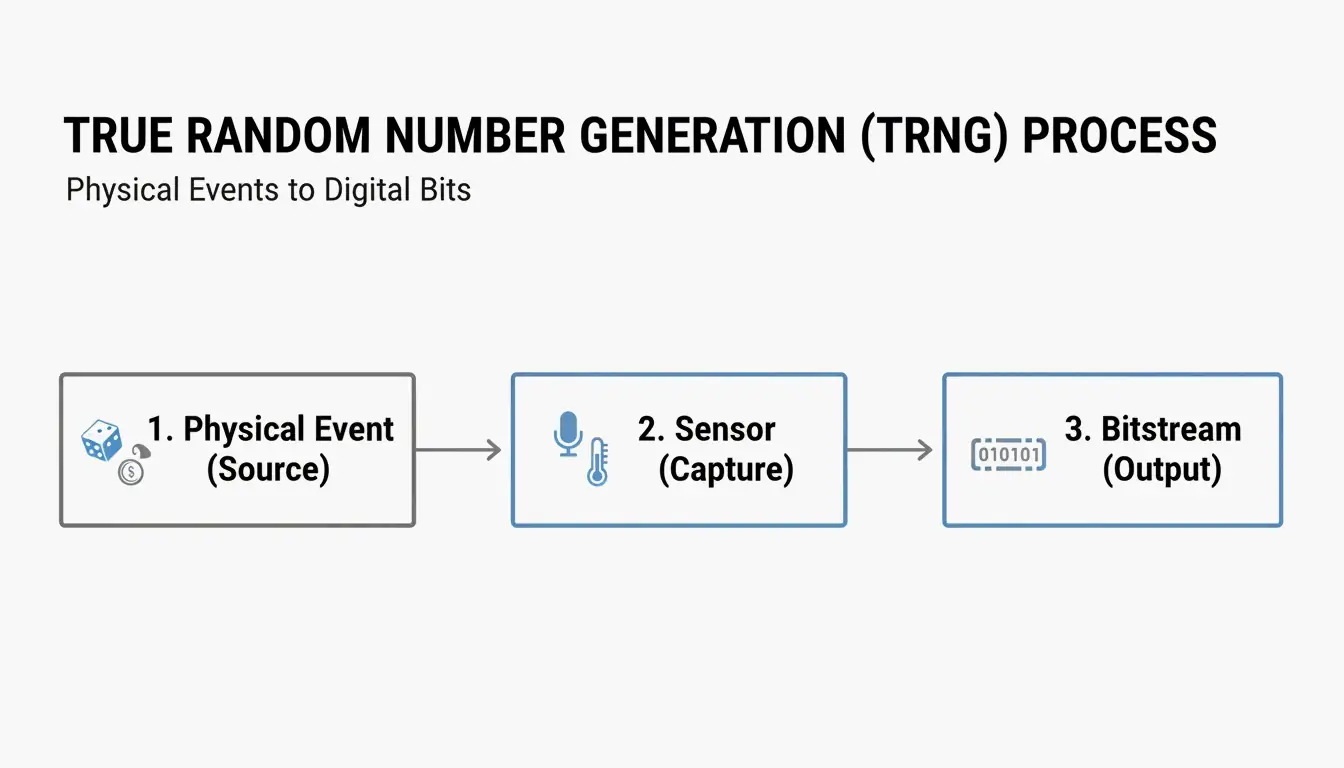
A True Random Number Generator (TRNG) — also called a Hardware Random Number Generator (HRNG) — does not follow a formula. It bridges the unpredictable physical world and the rigid logic of digital systems by capturing an external entropy source and converting its analog signal into a binary stream.
As John von Neumann warned in 1951: “Anyone who considers arithmetical methods of producing random digits is, of course, in a state of sin.”
Three Common Entropy Sources
| Source | What It Measures | Device Example |
|---|---|---|
| Thermal noise | Voltage fluctuations from electron movement in circuits | Smartphone Secure Enclaves (Apple A-series, Google Tensor) |
| Atmospheric noise | Radio static from natural events like lightning | Dedicated RNG servers |
| Quantum phenomena | Radioactive decay, vacuum fluctuations | ANU Quantum RNG, enterprise servers |
The pipeline is simple: Physical Source → Sensor/Digitizer → Binary Output. Raw entropy goes in one end; clean random bits come out the other.
TRNG vs PRNG: The Deterministic Divide
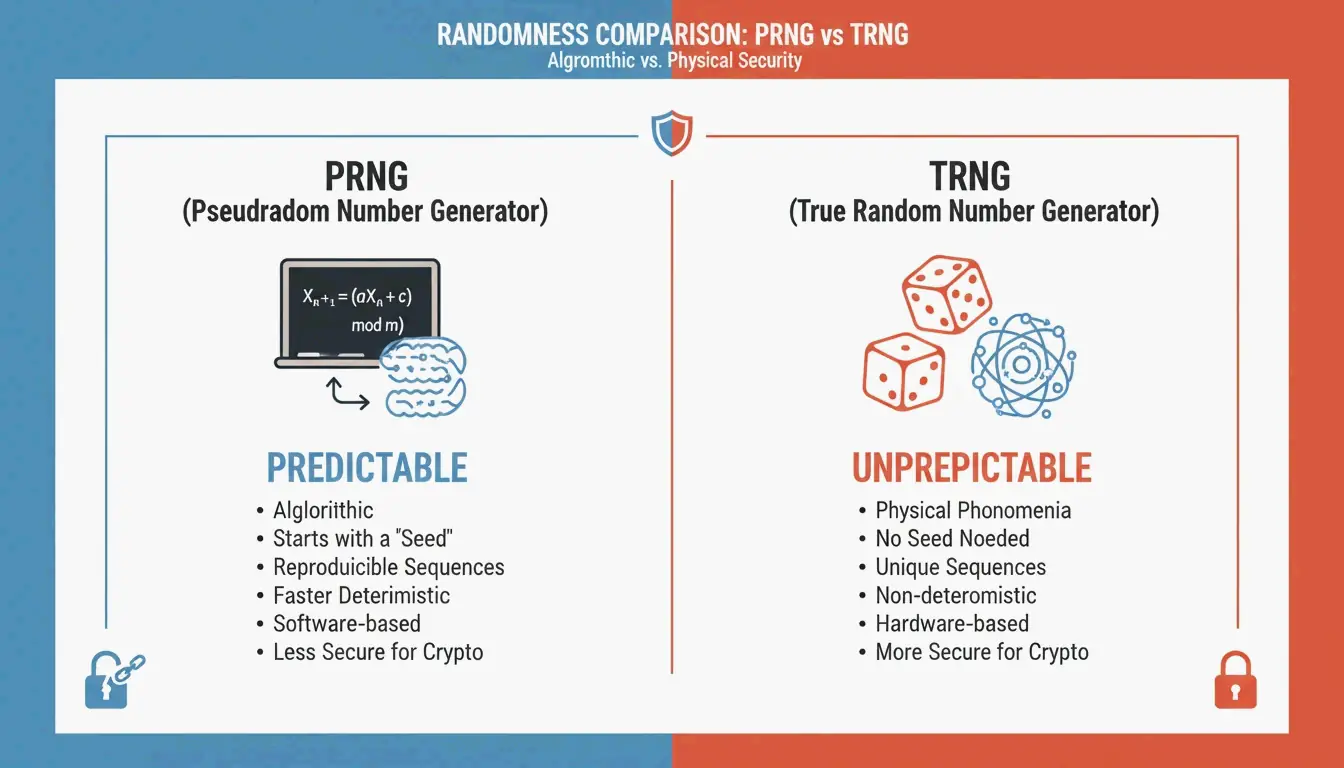
The core split in random number generation is between physical entropy and algorithmic logic.
| Property | TRNG (Hardware) | PRNG (Algorithmic) | CSPRNG (Hybrid) |
|---|---|---|---|
| Source | Physical entropy | Mathematical formula | Hardware seed + algorithm |
| Predictable? | No | Yes — if seed is known | Extremely difficult |
| Speed | Slower (blocking) | Very fast | Fast |
| Reproducible? | No | Yes (same seed = same output) | No |
| Use case | Encryption keys, security tokens | Simulations, games | Production security systems |
When PRNGs Fail: The Hot Lotto Fraud
A PRNG uses a seed value as a starting point for a mathematical formula. The output looks random but is entirely deterministic. If someone knows the seed and the formula, they can predict every number.
This is not theoretical. In the Hot Lotto Fraud Scandal, an insider installed malware that forced the PRNG to use a predictable seed during maintenance — rigging a $16.5 million jackpot.
When PRNGs Are the Right Choice
PRNGs are actually better for tasks where speed and reproducibility matter. In Monte Carlo simulations, scientists need to run the same sequence repeatedly to verify results. Because you can reuse the same seed, the simulation stays consistent — something a blocking TRNG cannot do.
The Hybrid Solution: CSPRNG
Most modern systems use a Cryptographically Secure Pseudorandom Number Generator (CSPRNG) — a hybrid that pulls a small amount of true hardware entropy to seed a fast algorithm. This gives the unpredictability of a TRNG with the speed of a PRNG.
The industry standard is NIST SP 800-90A, which defines how these generators must be built for government and industrial use.
Developer Guide: Which Library to Use
| Language | Insecure (PRNG) | Secure (CSPRNG) |
|---|---|---|
| Python | random (Mersenne Twister) |
secrets (reads from /dev/urandom) |
| JavaScript | Math.random() |
crypto.getRandomValues() |
| Go | math/rand |
crypto/rand |
| Java | java.util.Random |
java.security.SecureRandom |
The rule: use secrets / crypto / SecureRandom for anything security-related. Use random / Math.random() only for games and simulations.
TRNGs in 2026 Consumer Hardware
By 2026, hardware entropy has moved from enterprise servers into everyday devices. Modern smartphone chips include dedicated TRNGs inside their Secure Enclaves, harvesting thermal noise directly from the processor to generate encryption keys for FaceID, digital wallets, and secure messaging.
For enterprise security, the frontier is Quantum Random Number Generation. Systems like those at the Australian National University generate numbers from quantum vacuum fluctuations — a level of randomness that even future quantum computers likely cannot crack.
Whitening: From Raw Noise to Clean Data
Raw entropy is rarely uniform. A thermal sensor might produce slightly more 1s than 0s due to a temperature drift. To fix this bias, the data goes through whitening — typically an XOR operation or cryptographic hash — to smooth out patterns and ensure an even distribution.
This post-processing step is required by NIST SP 800-90B for any entropy source used in a certified system.
A Brief History of Harvesting Chaos
- 1927: L.H.C. Tippett published a table of 41,600 digits drawn manually from census records.
- 1955: RAND Corporation published A Million Random Digits using an electronic pulse machine.
- 2013: The Dual_EC_DRBG scandal revealed that the NSA had placed a backdoor in a NIST-certified generator, allowing them to crack SSL connections. This incident pushed the industry toward multi-source entropy mixing — no single point of failure.
Conclusion
Truly random numbers are the foundation of digital trust. They require physical hardware to bridge predictable code and chaotic reality. Whether it is thermal noise in your phone or quantum fluctuations in a server room, the shift from pseudo-randomness to hardware-verified entropy is essential for security in 2026.
For developers: use secrets (Python) or crypto.getRandomValues() (JavaScript), never random or Math.random() for security. For organizations: hardware TRNGs are no longer optional — they are a baseline requirement for encryption.
FAQ
Is my computer’s internal clock a source of true randomness?
No. The clock is predictable and is often used as a PRNG seed precisely because it changes. But if an attacker knows roughly when a number was generated, they can narrow the possibilities. True randomness requires timing non-deterministic events — keystroke intervals, thermal noise — followed by statistical whitening.
Can a human generate a truly random sequence?
Humans are poor at randomness. We avoid clusters (like “1, 1, 1”) even though they occur naturally in random sets, and we switch between options too frequently. Statistical tests detect these patterns easily, which is why human input is acceptable for seeding but insufficient for security-critical tasks.
What statistical tests verify true randomness?
The NIST Statistical Test Suite (STS) is the gold standard. Other frameworks include Dieharder tests and the AIS 31 standard. These tests hunt for repeating patterns, long runs of identical bits, and other anomalies that indicate bias or predictability.
Frequently Asked Questions
Is my computer’s internal clock a source of true randomness?
No. The clock is predictable and is often used as a PRNG seed precisely because it changes. But if an attacker knows roughly when a number was generated, they can narrow the possibilities. True randomness requires timing non-deterministic events — keystroke intervals, thermal noise — followed by statistical whitening.
Can a human generate a truly random sequence?
Humans are poor at randomness. We avoid clusters (like “1, 1, 1”) even though they occur naturally in random sets, and we switch between options too frequently. Statistical tests detect these patterns easily, which is why human input is acceptable for seeding but insufficient for security-critical tasks.
What statistical tests verify true randomness?
The NIST Statistical Test Suite (STS) is the gold standard. Other frameworks include Dieharder tests and the AIS 31 standard. These tests hunt for repeating patterns, long runs of identical bits, and other anomalies that indicate bias or predictability.
Related Posts

What Is an IMEI Number? Meaning, Format & How to Find It
Random Phone Number Generator: Testing, SMS Verification & DevOps Integration
SME Inventory Management: Build a Low-Cost Fixed Asset Barcode System in 2026