EAN-13 vs EAN-8 : quel format de code-barres pour votre produit ?
Résumé rapide
- Prenez n’importe quel produit en magasin et vous trouverez un code-barres quelque part sur l’emballage. Le plus souvent, il s’agit d’un EAN-13 : 13 chiffres étirés sur une bande familière de barres noires et blanches. Mais parfois, sur un tout petit article comme un paquet de chewing-gum ou un tube de baume à lèvres, vous apercevrez un code-barres plus court et plus compact : l’EAN-8.
- Prenez n’importe quel produit en magasin et vous trouverez un code-barres quelque part sur l’emballage.
- EAN-13 vs EAN-8 : les différences clés en un coup d’œil
Processus éditorial
Relu par SectoJoy et publié le 19 juin 2026. Cet article est mis à jour lorsque les détails du produit, les exemples ou les consignes d'utilisation évoluent. Dernière mise à jour : 19 juin 2026.
SectoJoy
Je suis un développeur indépendant créant des applications iOS et web, avec un focus sur les produits SaaS pratiques. Je me spécialise en SEO basé sur l'IA, en explorant constamment comment les technologies intelligentes peuvent stimuler la croissance durable et l'efficacité.
Prenez n’importe quel produit en magasin et vous trouverez un code-barres quelque part sur l’emballage. Le plus souvent, il s’agit d’un EAN-13 — 13 chiffres étirés sur une bande familière de barres noires et blanches. Mais parfois, sur un tout petit article comme un paquet de chewing-gum ou un tube de baume à lèvres, vous apercevrez un code-barres plus court et plus compact : l’EAN-8.
Les deux formats remplissent la même mission — donner à chaque produit un identifiant unique et scannable — mais ils sont conçus pour des situations différentes. Ce guide passe en revue les vraies différences entre l’EAN-13 et l’EAN-8, quand utiliser chacun et comment ils s’intègrent dans l’écosystème plus large des codes-barres GS1.
EAN-13 vs EAN-8 : les différences clés en un coup d’œil
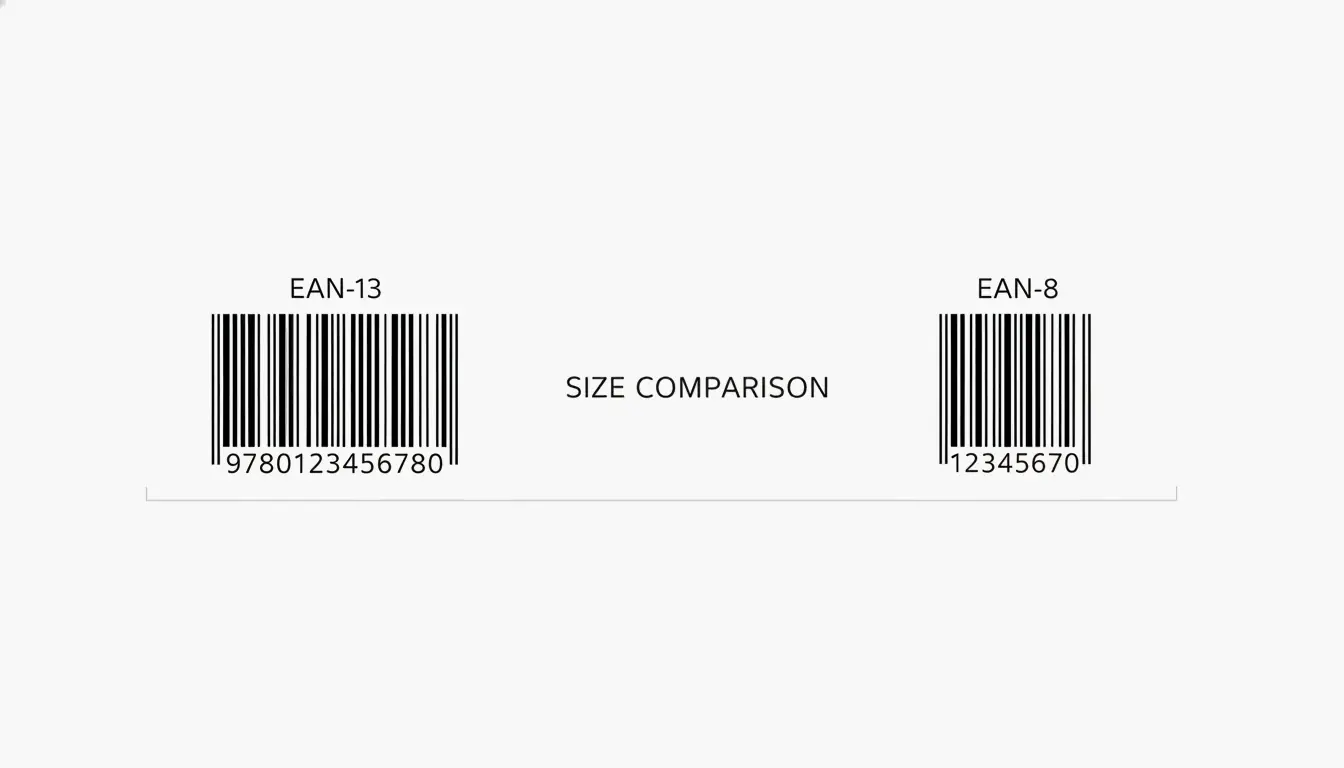
La distinction la plus importante entre ces deux formats tient à combien de chiffres ils transportent et à l’espace physique qu’ils occupent sur l’étiquette.
| Fonctionnalité | EAN-13 | EAN-8 |
|---|---|---|
| Chiffres | 13 | 8 |
| Largeur en modules | 95 modules | 67 modules |
| Largeur d’impression minimale | ~1,5 pouces (38 mm) | ~1 pouce (26 mm) |
| Usage typique | Produits de grande distribution standard | Très petits emballages |
| Géré par | GS1 | GS1 |
Un code-barres EAN-13 encode 13 chiffres et se compose de 95 modules de largeur égale, selon Wikipédia. L’EAN-8 n’encode que 8 chiffres, ce qui produit un code-barres beaucoup plus étroit — environ deux tiers de la largeur.
Comment choisir : un arbre de décision simple
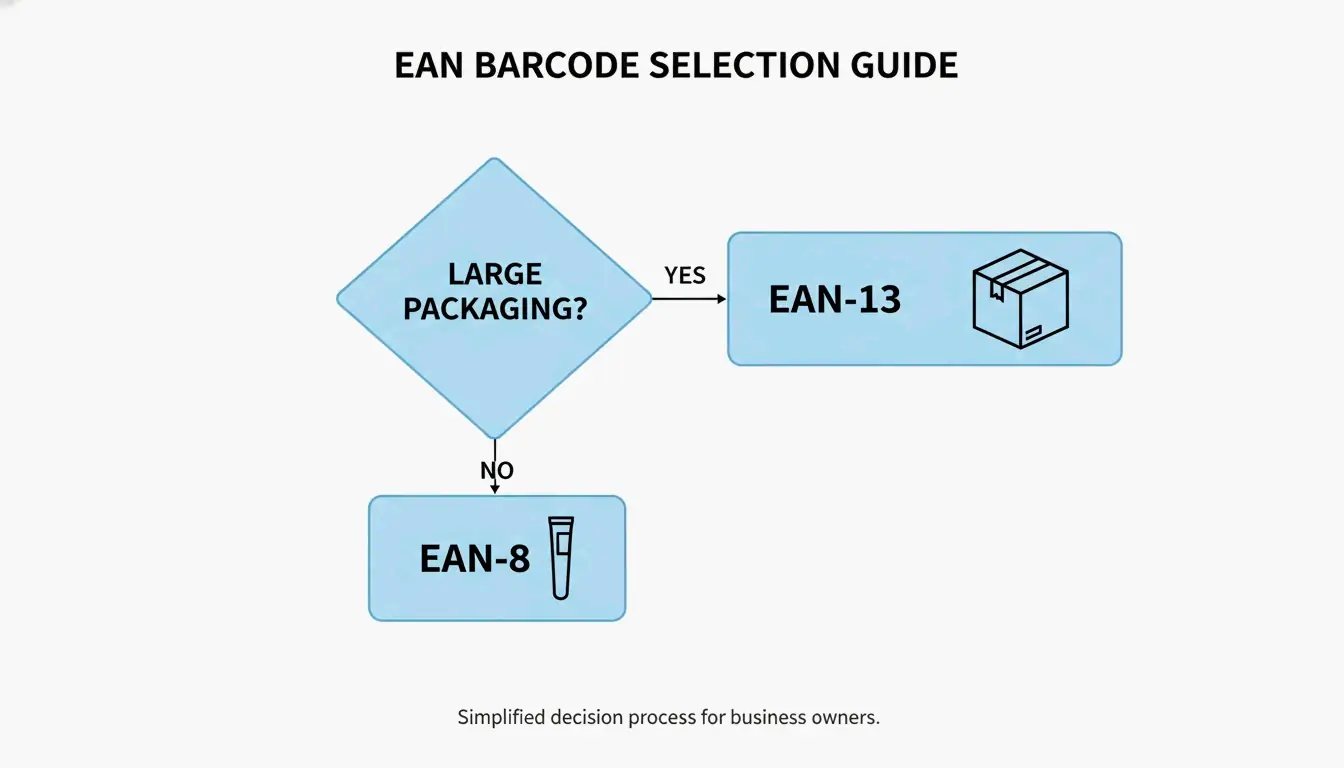
Pour quiconque doit décider quel format utiliser, la logique est directe :
- Produits standard — Si votre emballage a la place pour un code-barres d’au moins 1,5 pouce de large, optez pour l’EAN-13. C’est l’exigence par défaut pour la grande distribution dans le monde entier.
- Petits articles — Si la zone imprimable de votre produit est trop étroite pour l’EAN-13, vous pouvez demander un EAN-8.
Un élément souvent négligé est la Zone de silence (Quiet Zone) — l’espace blanc de chaque côté du code-barres. Selon Wikipédia, les codes EAN-13 comportent fréquemment un indicateur > côté droit qui marque le début de la Zone de silence. Ce repère visuel aide les scanners à trouver les bords du code afin qu’ils ne soient pas perturbés par les graphismes ou le texte voisins.
Quand l’EAN-8 est le bon choix : la règle de la surface
L’EAN-8 n’est pas une alternative gratuite — c’est un format spécialisé pour les produits qui ne peuvent vraiment pas accueillir un code-barres standard. Comme l’explique Barcodes South Africa, comme seuls 8 chiffres sont disponibles (bien moins de combinaisons uniques qu’avec 13 chiffres), les organismes membres GS1 n’attribuent des numéros EAN-8 qu’aux fabricants qui peuvent démontrer que leur emballage est trop petit pour l’EAN-13.
En pratique, vous verrez donc l’EAN-8 sur des articles comme :
– Barres chocolatées individuelles ou paquets de chewing-gum
– Petits articles de cosmétique (baume à lèvres, mascara)
– Sachets de graines ou d’épices
– Petits accessoires électroniques
Si votre produit dispose de suffisamment d’espace, l’EAN-13 reste toujours la valeur par défaut.
Spécifications techniques : comment sont structurés les formats EAN ?
Derrière les barres, les formats EAN suivent une structure précise qui garantit à chaque produit un identifiant unique au niveau mondial via le système GS1 (Global Standards 1).
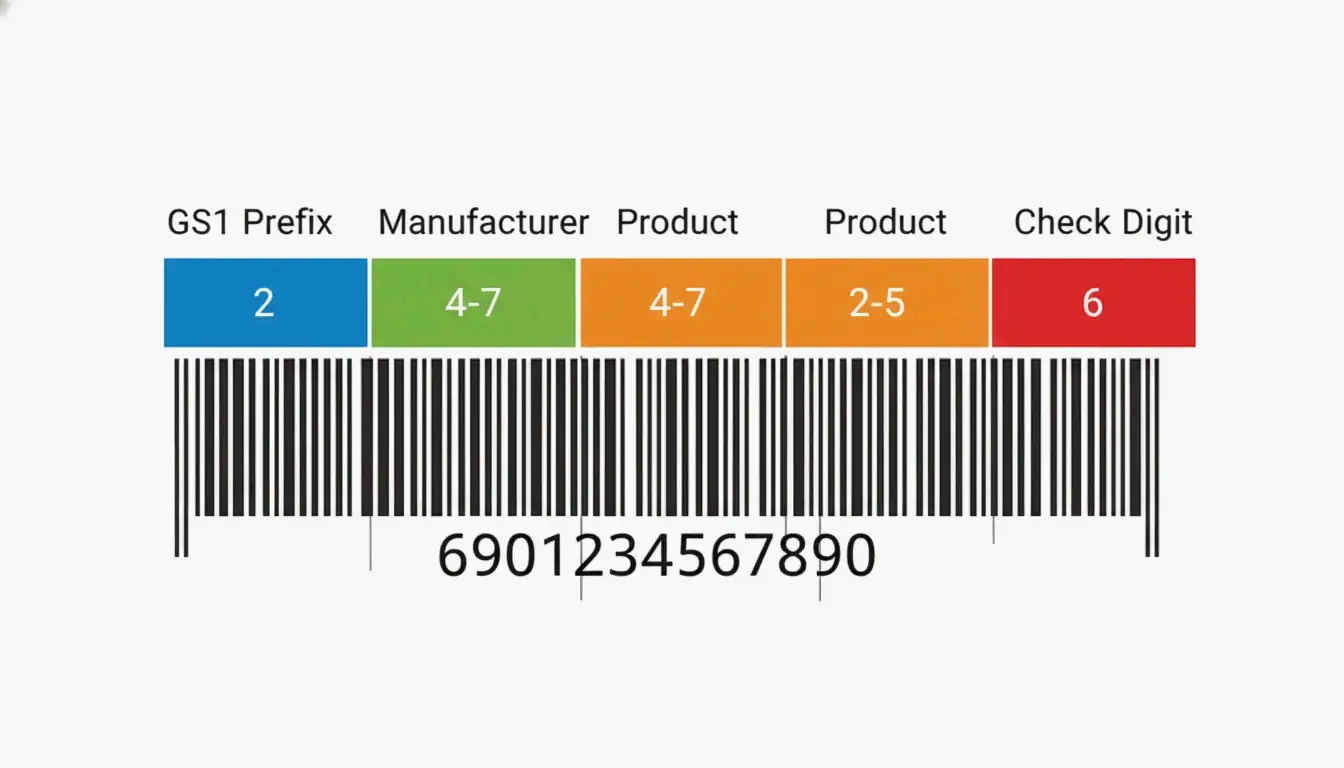
Structure de l’EAN-13 :
- Préfixe GS1 (3 chiffres) : Identifie quel organisme membre GS1 a émis le code. Par exemple,
590correspond à la Pologne,400–440à l’Allemagne. - Code fabricant (longueur variable) : L’identifiant unique attribué à une entreprise.
- Code produit (longueur variable) : Le numéro spécifique que l’entreprise attribue à un article donné (l’équivalent du SKU).
- Chiffre de contrôle (1 chiffre) : Le dernier chiffre, calculé à partir de tous les chiffres précédents pour détecter les erreurs de scan.
Structure de l’EAN-8 :
L’EAN-8 fonctionne différemment — il n’y a pas de code fabricant à longueur variable. L’autorité de numérotation attribue les codes produit directement. Selon Oracle, n’importe quelle entreprise peut demander un EAN-8 même si elle détient déjà un préfixe EAN-13, mais les deux numéros n’ont aucun lien mathématique entre eux.
Les deux formats sont remarquablement fiables pour détecter les erreurs. Wikipédia indique que l’EAN-13 détecte 100 % des erreurs sur un seul chiffre et 90 % des erreurs de transposition (lorsque deux chiffres adjacents sont inversés). Cela signifie que si un scanner se trompe sur ne serait-ce qu’une barre, le chiffre de contrôle le signalera presque toujours.
L’EAN-13 est-il accepté aux États-Unis ? Comparaison avec l’UPC-A
Une préoccupation courante pour les entreprises qui vendent à l’international est de savoir si l’EAN-13 fonctionne aux États-Unis, qui utilisaient historiquement leur propre format UPC-A à 12 chiffres.
Réponse courte : oui, totalement. L’initiative « 2005 Sunrise » — aujourd’hui une politique de longue date — exige que chaque système de point de vente aux États-Unis et au Canada accepte à la fois l’EAN-13 et l’UPC-A. En fait, l’EAN-13 est techniquement un sur-ensemble de l’UPC-A. Un code-barres UPC-A est tout simplement un EAN-13 dont le premier chiffre est 0.
Ce que cela signifie en pratique :
– Si vous êtes une marque mondiale, vous pouvez utiliser l’EAN-13 partout — aucun besoin de codes UPC-A séparés.
– Les distributeurs américains peuvent scanner vos produits EAN-13 sans aucun changement de configuration.
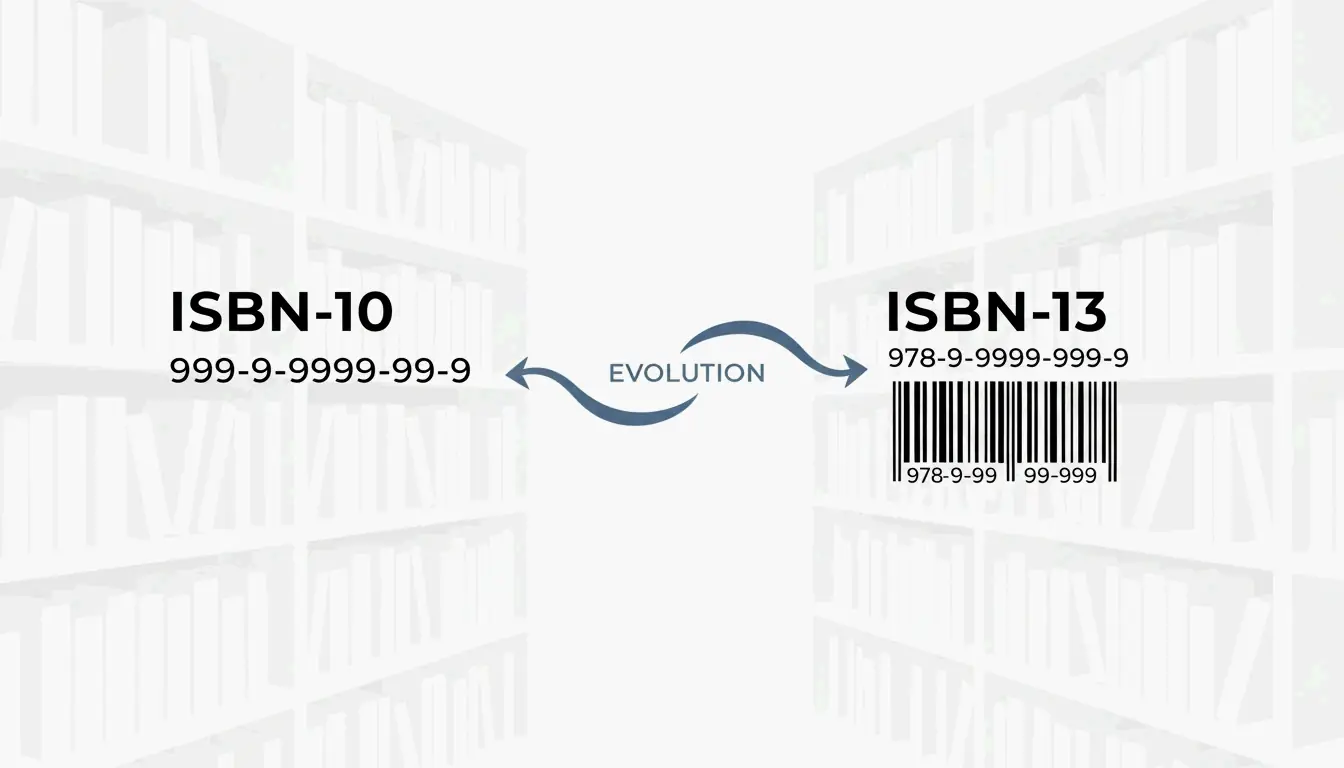
Il existe également des préfixes spécialisés dans le système EAN-13 qu’il est utile de connaître. Les préfixes Bookland (978 et 979) intègrent les ISBN directement dans l’EAN-13, ce qui permet de scanner les livres à n’importe quelle caisse de magasin standard, quel que soit leur pays d’édition.
Intégration GTIN et normalisation des bases de données
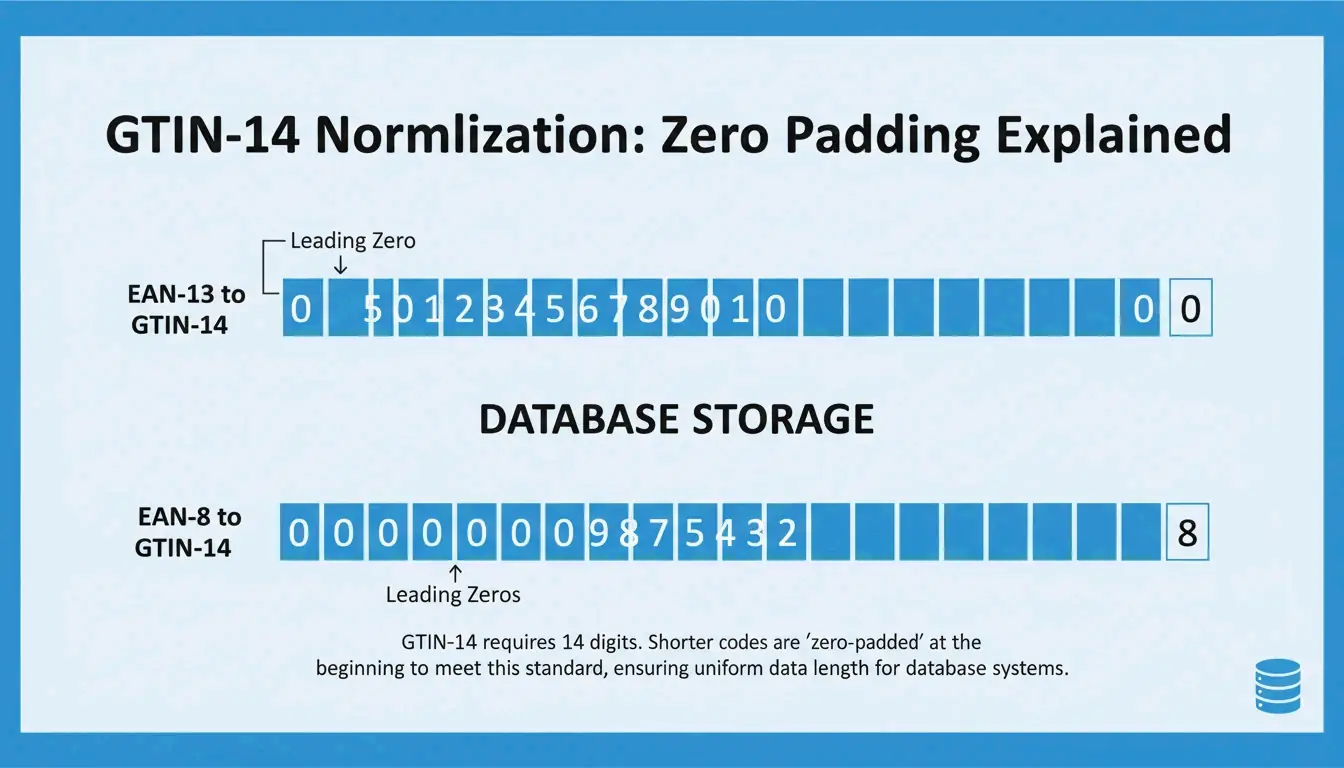
L’EAN-13 comme l’EAN-8 font partie de la famille du Global Trade Item Number (GTIN). Lorsque des produits avec des codes-barres de longueurs différentes se retrouvent dans la même base de données — par exemple, un système de gestion d’entrepôt — ils ont besoin d’un format cohérent. C’est là qu’intervient le GTIN-14.
La normalisation est simple : on complète les codes plus courts avec des zéros non significatifs.
| Code-barres | GTIN-14 |
|---|---|
EAN-13 : 4006381333931 |
04006381333931 (1 zéro non significatif) |
EAN-8 : 96385074 |
00000096385074 (6 zéros non significatifs) |
Dans des systèmes comme Oracle WMS, tous les GTIN sont alignés à droite et complétés à 14 chiffres afin qu’un seul champ de base de données puisse tout gérer, d’un tube de baume à lèvres à une palette entière.
Comment calculer le chiffre de contrôle (Modulo-10, étape par étape)
Le dernier chiffre d’un code-barres EAN n’est pas aléatoire — il est calculé à l’aide de l’algorithme Modulo-10. Les logiciels modernes s’en chargent automatiquement, mais comprendre le calcul est utile si vous générez des codes-barres par programmation ou dépannez un problème de scan.
Exemple : vérifier le chiffre de contrôle de l’EAN-13 400638133393?
Étape 1 — En partant de la droite (hors chiffre de contrôle), attribuez alternativement des poids de 3 et 1 :
| Position | 12 | 11 | 10 | 9 | 8 | 7 | 6 | 5 | 4 | 3 | 2 | 1 |
|---|---|---|---|---|---|---|---|---|---|---|---|---|
| Chiffre | 4 | 0 | 0 | 6 | 3 | 8 | 1 | 3 | 3 | 3 | 9 | 3 |
| Poids | 1 | 3 | 1 | 3 | 1 | 3 | 1 | 3 | 1 | 3 | 1 | 3 |
| Produit | 4 | 0 | 0 | 18 | 3 | 24 | 1 | 9 | 3 | 9 | 9 | 9 |
Étape 2 — Additionnez tous les produits : 4 + 0 + 0 + 18 + 3 + 24 + 1 + 9 + 3 + 9 + 9 + 9 = 89
Étape 3 — Trouvez le multiple de 10 suivant (soit 90). Soustrayez : 90 − 89 = 1.
Le chiffre de contrôle est 1, ce qui donne le code-barres complet 4006381333931.
C’est une bonne vérification de cohérence à effectuer lors de la conception des étiquettes — détecter un mauvais chiffre de contrôle avant d’imprimer des milliers d’étiquettes fait gagner du temps et de l’argent.
Conclusion
L’EAN-13 est le cheval de bataille mondial du code-barres de détail — c’est ce que vous utiliserez pour la grande majorité des produits. L’EAN-8 est l’alternative compacte, réservée aux articles dont l’espace d’emballage est vraiment trop restreint pour un code-barres standard. Les deux formats sont gérés par GS1, utilisent le même système de chiffre de contrôle Modulo-10, et sont scannés de façon fiable par tous les systèmes de caisse modernes dans le monde — y compris aux États-Unis et au Canada.
La décision se résume à la surface disponible. Si votre emballage peut accueillir un code-barres d’au moins 1,5 pouce de large, utilisez l’EAN-13. Si ce n’est pas possible, demandez un EAN-8 auprès de votre bureau GS1 local. Dans tous les cas, votre produit sera scanné correctement tout au long de la chaîne d’approvisionnement.
FAQ
Puis-je convertir un code EAN-8 en code EAN-13 ?
Non — ce sont des identifiants totalement distincts. Les numéros EAN-8 sont attribués directement par GS1 et n’ont aucun lien avec votre préfixe fabricant EAN-13. Si vous avez besoin d’un code EAN-13, vous devrez utiliser un numéro issu de votre bloc EAN-13 attribué.
L’EAN-13 est-il accepté aux États-Unis et au Canada ?
Oui. Depuis l’accord 2005 Sunrise, tous les systèmes de caisse modernes en Amérique du Nord scannent à la fois l’UPC-A et l’EAN-13 sans difficulté. La plupart des marques mondiales utilisent désormais l’EAN-13 exclusivement pour simplifier les choses sur tous les marchés.
Que se passe-t-il si je scanne un code-barres EAN-8 dans un système qui attend 14 chiffres ?
Le système ajoutera des zéros non significatifs au code à 8 chiffres en y ajoutant six zéros pour remplir le champ GTIN-14 (par exemple 000000XXXXXXXX). C’est une pratique standard dans des systèmes comme Oracle WMS afin de maintenir des enregistrements de base de données cohérents entre les différentes tailles de produits.
Questions fréquentes
Spécifications techniques : comment sont structurés les formats EAN ?
Derrière les barres, les formats EAN suivent une structure précise qui garantit à chaque produit un identifiant unique au niveau mondial via le système GS1 (Global Standards 1). Structure de l’EAN-13 :
Puis-je convertir un code EAN-8 en code EAN-13 ?
Non — ce sont des identifiants totalement distincts. Les numéros EAN-8 sont attribués directement par GS1 et n’ont aucun lien avec votre préfixe fabricant EAN-13. Si vous avez besoin d’un code EAN-13, vous devrez utiliser un numéro issu de votre bloc EAN-13 attribué.
L’EAN-13 est-il accepté aux États-Unis et au Canada ?
Oui. Depuis l’accord 2005 Sunrise, tous les systèmes de caisse modernes en Amérique du Nord scannent à la fois l’UPC-A et l’EAN-13 sans difficulté. La plupart des marques mondiales utilisent désormais l’EAN-13 exclusivement pour simplifier les choses sur tous les marchés.
Que se passe-t-il si je scanne un code-barres EAN-8 dans un système qui attend 14 chiffres ?
Le système ajoutera des zéros non significatifs au code à 8 chiffres en y ajoutant six zéros pour remplir le champ GTIN-14 (par exemple 000000XXXXXXXX). C’est une pratique standard dans des systèmes comme Oracle WMS afin de maintenir des enregistrements de base de données cohérents entre les différentes tailles de produits.
Articles associés
Code 128 vs Code 39 : différences de code-barres expliquées (2026)