Como são gerados números verdadeiramente aleatórios: TRNG, PRNG e CSPRNG explicados
Resumo rápido
- A geração de números verdadeiramente aleatórios coleta entropia física — ruído térmico, estática atmosférica, decaimento quântico — e converte esses sinais analógicos caóticos em bits digitais.
- A geração de números verdadeiramente aleatórios funciona coletando entropia física — ruído térmico, estática atmosférica, decaimento quântico — e convertendo esses sinais analógicos caóticos em bits digitais.
- Como funciona um TRNG: do caos físico aos bits digitais
Processo editorial
Revisado por SectoJoy e publicado em 19 de junho de 2026. Atualizamos este artigo quando os detalhes do produto, exemplos ou guia da ferramenta mudam. Última atualização: 19 de junho de 2026.
SectoJoy
Sou um desenvolvedor independente que cria aplicativos iOS e web, focado em produtos SaaS práticos. Tenho especialização em SEO com IA, explorando constantemente como tecnologias inteligentes podem impulsionar crescimento sustentável e eficiência.
A geração de números verdadeiramente aleatórios funciona coletando entropia física — ruído térmico, estática atmosférica, decaimento quântico — e convertendo esses sinais analógicos caóticos em bits digitais. Diferente dos geradores baseados em algoritmos, sistemas orientados por hardware medem variáveis ambientais não determinísticas para produzir sequências matematicamente imprevisíveis e sem padrões.
Veja como a tecnologia funciona, onde ela falha e como escolher a abordagem certa para o seu caso de uso.
Como funciona um TRNG: do caos físico aos bits digitais
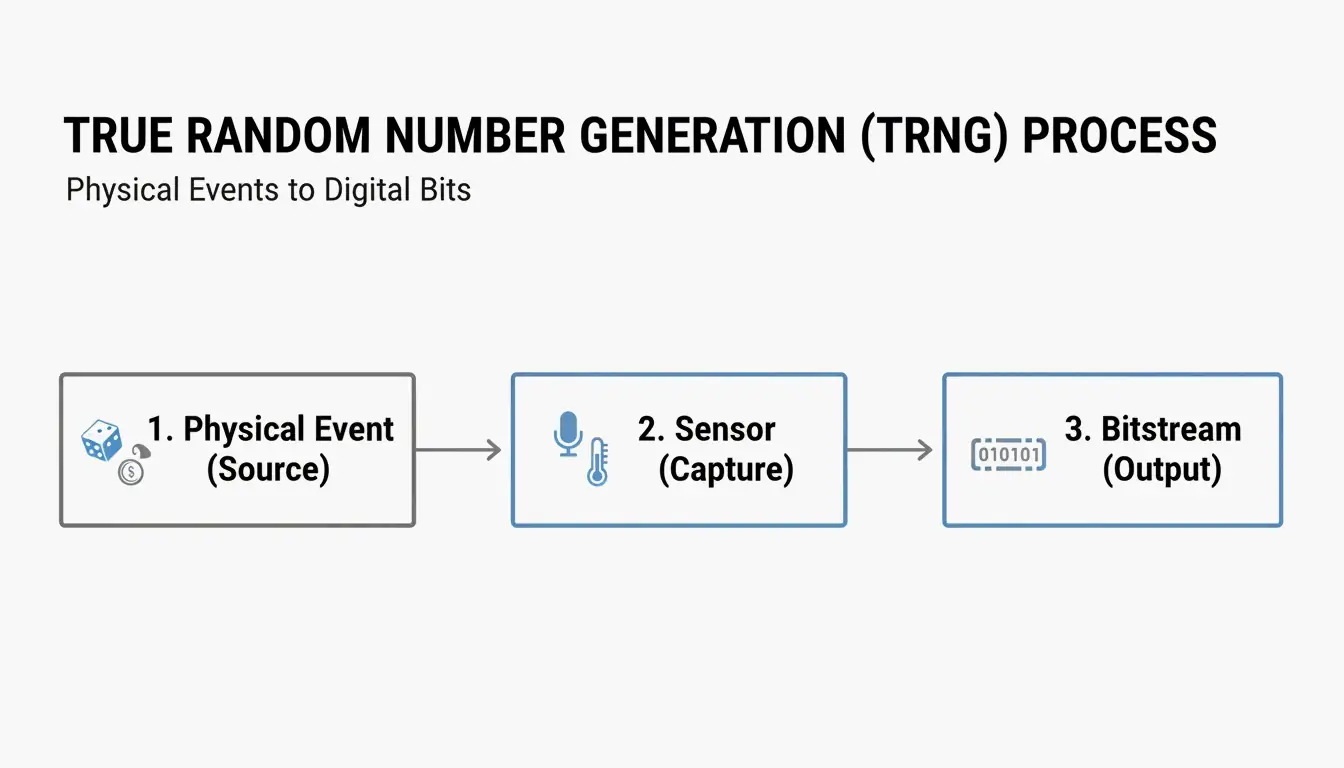
Um Gerador de Números Verdadeiramente Aleatórios (TRNG) — também chamado de Gerador de Números Aleatórios por Hardware (HRNG) — não segue uma fórmula. Ele faz a ponte entre o mundo físico imprevisível e a lógica rígida dos sistemas digitais, capturando uma fonte de entropia externa e convertendo seu sinal analógico em um fluxo binário.
Como John von Neumann alertou em 1951: “Qualquer pessoa que considere métodos aritméticos para produzir dígitos aleatórios está, naturalmente, em estado de pecado.”
Três fontes de entropia comuns
| Fonte | O que mede | Exemplo de dispositivo |
|---|---|---|
| Ruído térmico | Flutuações de tensão causadas pelo movimento de elétrons nos circuitos | Secure Enclaves de smartphones (Apple série A, Google Tensor) |
| Ruído atmosférico | Estática de rádio de eventos naturais como raios | Servidores RNG dedicados |
| Fenômenos quânticos | Decaimento radioativo, flutuações de vácuo | ANU Quantum RNG, servidores corporativos |
O pipeline é simples: Fonte Física → Sensor/Digitizador → Saída Binária. A entropia bruta entra por uma ponta; bits aleatórios limpos saem pela outra.
TRNG vs PRNG: a divisão determinística
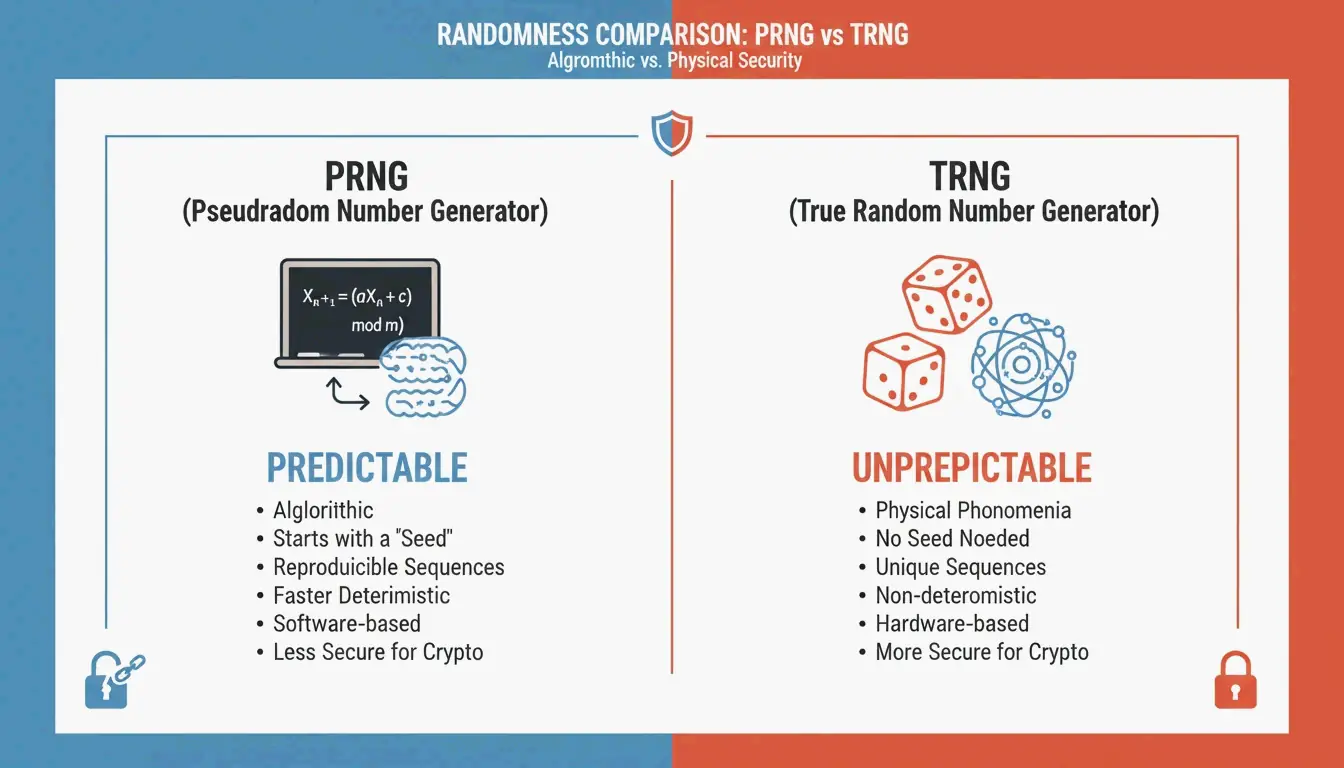
A divisão central na geração de números aleatórios está entre a entropia física e a lógica algorítmica.
| Propriedade | TRNG (Hardware) | PRNG (Algorítmico) | CSPRNG (Híbrido) |
|---|---|---|---|
| Fonte | Entropia física | Fórmula matemática | Seed de hardware + algoritmo |
| Previsível? | Não | Sim — se a seed for conhecida | Extremamente difícil |
| Velocidade | Mais lento (bloqueante) | Muito rápido | Rápido |
| Reproduzível? | Não | Sim (mesma seed = mesma saída) | Não |
| Caso de uso | Chaves de criptografia, tokens de segurança | Simulações, jogos | Sistemas de segurança em produção |
Quando os PRNGs falham: a fraude do Hot Lotto
Um PRNG usa um valor de seed como ponto de partida para uma fórmula matemática. A saída parece aleatória, mas é totalmente determinística. Se alguém conhece a seed e a fórmula, consegue prever todos os números.
Isso não é teórico. Na Fraude do Hot Lotto, um insider instalou um malware que forçou o PRNG a usar uma seed previsível durante a manutenção — manipulando um prêmio de US$ 16,5 milhões.
Quando os PRNGs são a escolha certa
PRNGs são, na verdade, melhores para tarefas em que velocidade e reprodutibilidade importam. Em simulações de Monte Carlo, cientistas precisam executar a mesma sequência repetidamente para verificar resultados. Como é possível reusar a mesma seed, a simulação se mantém consistente — algo que um TRNG bloqueante não consegue fazer.
A solução híbrida: CSPRNG
A maioria dos sistemas modernos usa um Gerador de Números Pseudoaleatórios Criptograficamente Seguro (CSPRNG) — um híbrido que extrai uma pequena quantidade de entropia real de hardware para semear um algoritmo rápido. Isso oferece a imprevisibilidade de um TRNG com a velocidade de um PRNG.
O padrão da indústria é o NIST SP 800-90A, que define como esses geradores devem ser construídos para uso governamental e industrial.
Guia para desenvolvedores: qual biblioteca usar
| Linguagem | Inseguro (PRNG) | Seguro (CSPRNG) |
|---|---|---|
| Python | random (Mersenne Twister) |
secrets (lê de /dev/urandom) |
| JavaScript | Math.random() |
crypto.getRandomValues() |
| Go | math/rand |
crypto/rand |
| Java | java.util.Random |
java.security.SecureRandom |
A regra: use secrets / crypto / SecureRandom para qualquer coisa relacionada a segurança. Use random / Math.random() apenas para jogos e simulações.
TRNGs no hardware de consumo em 2026
Em 2026, a entropia de hardware migrou dos servidores corporativos para os dispositivos do dia a dia. Chips modernos de smartphones incluem TRNGs dedicados dentro de seus Secure Enclaves, coletando ruído térmico diretamente do processador para gerar chaves de criptografia para FaceID, carteiras digitais e mensagens seguras.
Para segurança corporativa, a fronteira é a Geração de Números Aleatórios Quânticos. Sistemas como os da Australian National University geram números a partir de flutuações de vácuo quântico — um nível de aleatoriedade que, provavelmente, nem computadores quânticos do futuro conseguirão quebrar.
Whitening: do ruído bruto aos dados limpos
A entropia bruta raramente é uniforme. Um sensor térmico pode produzir ligeiramente mais 1s do que 0s devido a uma variação de temperatura. Para corrigir esse viés, os dados passam por um whitening — normalmente uma operação XOR ou um hash criptográfico — para suavizar padrões e garantir uma distribuição uniforme.
Essa etapa de pós-processamento é exigida pelo NIST SP 800-90B para qualquer fonte de entropia usada em um sistema certificado.
Um breve histórico da coleta do caos
- 1927: L.H.C. Tippett publicou uma tabela de 41.600 dígitos extraídos manualmente de registros de censo.
- 1955: A RAND Corporation publicou A Million Random Digits usando uma máquina de pulsos eletrônicos.
- 2013: O escândalo do Dual_EC_DRBG revelou que a NSA havia colocado uma backdoor em um gerador certificado pelo NIST, permitindo quebrar conexões SSL. Esse incidente empurrou a indústria em direção à mistura de entropia de múltiplas fontes — nenhum ponto único de falha.
Conclusão
Números verdadeiramente aleatórios são a base da confiança digital. Eles exigem hardware físico para conectar o código previsível à realidade caótica. Seja o ruído térmico no seu telefone ou as flutuações quânticas em uma sala de servidores, a transição da pseudoaleatoriedade para a entropia verificada por hardware é essencial para a segurança em 2026.
Para desenvolvedores: use secrets (Python) ou crypto.getRandomValues() (JavaScript), nunca random ou Math.random() para segurança. Para organizações: TRNGs de hardware não são mais opcionais — são um requisito básico para criptografia.
FAQ
O relógio interno do meu computador é uma fonte de aleatoriedade verdadeira?
Não. O relógio é previsível e costuma ser usado como seed de PRNG justamente porque muda. Mas se um atacante souber aproximadamente quando um número foi gerado, ele pode reduzir as possibilidades. Aleatoriedade verdadeira exige medir eventos não determinísticos — intervalos entre teclas, ruído térmico — seguidos de whitening estatístico.
Um ser humano consegue gerar uma sequência verdadeiramente aleatória?
Humanos são ruins em aleatoriedade. Evitamos agrupamentos (como “1, 1, 1”) mesmo que eles ocorram naturalmente em conjuntos aleatórios, e alternamos entre opções com muita frequência. Testes estatísticos detectam esses padrões com facilidade, por isso a entrada humana é aceitável para semear, mas insuficiente para tarefas críticas de segurança.
Quais testes estatísticos verificam aleatoriedade verdadeira?
O NIST Statistical Test Suite (STS) é o padrão ouro. Outros frameworks incluem os testes Dieharder e o padrão AIS 31. Esses testes procuram padrões repetitivos, longas sequências de bits idênticos e outras anomalias que indicam viés ou previsibilidade.
Perguntas frequentes
O relógio interno do meu computador é uma fonte de aleatoriedade verdadeira?
Não. O relógio é previsível e costuma ser usado como seed de PRNG justamente porque muda. Mas se um atacante souber aproximadamente quando um número foi gerado, ele pode reduzir as possibilidades. Aleatoriedade verdadeira exige medir eventos não determinísticos — intervalos entre teclas, ruído térmico — seguidos de whitening estatístico.
Um ser humano consegue gerar uma sequência verdadeiramente aleatória?
Humanos são ruins em aleatoriedade. Evitamos agrupamentos (como “1, 1, 1”) mesmo que eles ocorram naturalmente em conjuntos aleatórios, e alternamos entre opções com muita frequência. Testes estatísticos detectam esses padrões com facilidade, por isso a entrada humana é aceitável para semear, mas insuficiente para tarefas críticas de segurança.
Quais testes estatísticos verificam aleatoriedade verdadeira?
O NIST Statistical Test Suite (STS) é o padrão ouro. Outros frameworks incluem os testes Dieharder e o padrão AIS 31. Esses testes procuram padrões repetitivos, longas sequências de bits idênticos e outras anomalias que indicam viés ou previsibilidade.
Artigos Relacionados
Gerador de Números de Telefone Aleatórios: Testes, Verificação por SMS & Integração DevOps
Gestão de Estoque para PMEs: Monte um Sistema de Código de Barras para Ativos Fixos com Baixo Custo em 2026

Como escolher um vencedor de rifa de forma justa: o guia definitivo para sorteios aleatórios e legais