Gerador de Nome e Número Aleatório: Crie Nomes de Usuário, Códigos de Concurso e Tags de Jogo com Aleatoriedade Combinada
Resumo rápido
- Um gerador de nome e número aleatório cria resultados combinados que emparelham letras com números em uma única operação, ideal para nomes de usuário únicos, códigos promocionais e tags de jogos.
- Um gerador de nome e número aleatório cria resultados combinados que emparelham letras (nomes ou palavras) com números em uma única operação.
- O que é um Gerador de Nome e Número Aleatório e como ele funciona?
Processo editorial
Revisado por SectoJoy e publicado em 21 de junho de 2026. Atualizamos este artigo quando os detalhes do produto, exemplos ou guia da ferramenta mudam. Última atualização: 21 de junho de 2026.
SectoJoy
Sou um desenvolvedor independente que cria aplicativos iOS e web, focado em produtos SaaS práticos. Tenho especialização em SEO com IA, explorando constantemente como tecnologias inteligentes podem impulsionar crescimento sustentável e eficiência.
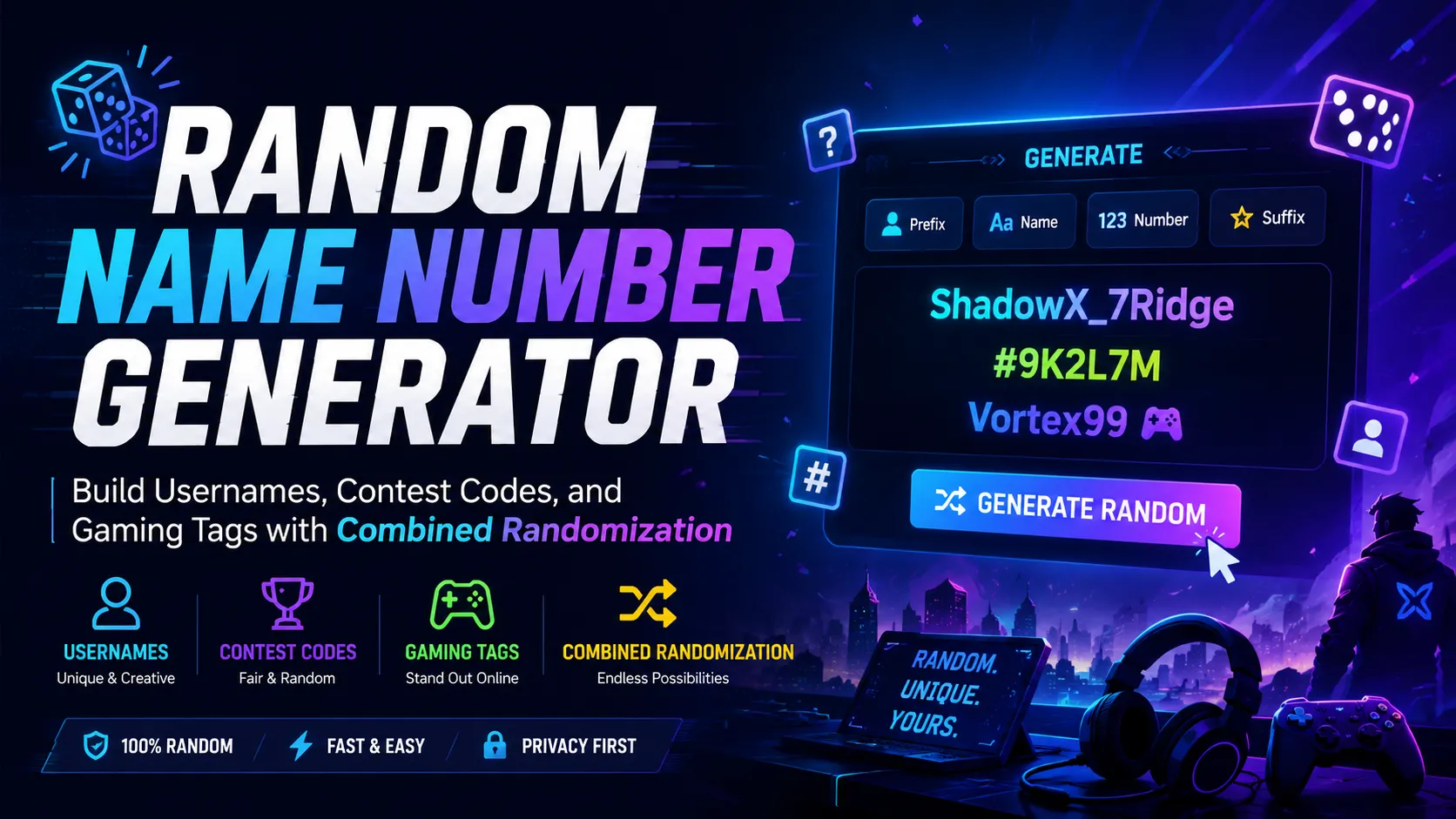
Um gerador de nome e número aleatório cria resultados combinados que emparelham letras (nomes ou palavras) com números em uma única operação. Diferente das ferramentas autônomas de números aleatórios que só produzem dígitos, ou dos geradores de nomes que apenas escolhem de uma lista, um gerador combinado funde os dois tipos de dados em um único resultado — algo como “DragonFury#4827” ou “Contest-Alpha-7041”. Não importa se você precisa de nomes de usuário únicos para uma plataforma, códigos estilo loteria para uma promoção ou tags de jogo aleatórias para um torneio, uma ferramenta capaz de gerar nomes aleatórios emparelhados com números aleatórios simultaneamente economiza tempo e elimina duplicação. Para um entendimento mais amplo de como a aleatoriedade funciona nos bastidores, nosso guia do number random generator abrange todo o espectro de técnicas.
Este artigo explora a mecânica, os casos de uso e as estratégias de implementação para a geração combinada de nomes e números. Abordamos como as ferramentas online lidam com isso, como construir seu próprio gerador em código e por que esse tipo específico de aleatoriedade é importante em aplicações do mundo real, desde jogos até segurança empresarial.
O que é um Gerador de Nome e Número Aleatório e como ele funciona?
Um gerador de nome e número aleatório é uma ferramenta híbrida que produz resultados contendo tanto caracteres alfabéticos quanto dígitos numéricos em um formato estruturado ou semiestruturado. O componente de “nome” normalmente vem de uma lista de palavras curada, um dicionário ou um banco de dados de nomes comuns, enquanto o componente de “número” é gerado por um algoritmo de número aleatório.
O fluxo de trabalho básico é assim:
- Selecionar um conjunto de nomes — Pode ser nomes próprios, combinações adjetivo-substantivo, palavras de fantasia ou vocabulário temático.
- Gerar um número aleatório — Um PRNG produz um número dentro de um intervalo especificado (ex.: 1000-9999).
- Combiná-los — O nome e o número são concatenados com um delimitador (cerquilha, hífen, underscore ou nada).
- Verificar unicidade — O resultado é comparado com resultados existentes para evitar colisões.
A força do resultado depende de dois fatores: o tamanho do conjunto de nomes e o intervalo do componente numérico. Um conjunto de 10.000 nomes emparelhado com números de 0 a 9999 gera até 100 milhões de combinações únicas. Essa escala é o que torna essa abordada viável para plataformas com milhões de usuários.
A matemática por trás da probabilidade de colisão
Se você está gerando identificadores para uma base de usuários, a probabilidade de colisão importa. O Paradoxo do Aniversário se aplica aqui: com N combinações possíveis e k identificadores gerados, a probabilidade de pelo menos uma colisão é aproximadamente:
P(collision) ≈ 1 - e^(-k² / 2N)
Por exemplo, com 10 milhões de combinações possíveis e 10.000 usuários, a probabilidade de colisão é de aproximadamente 0,5% — baixa, mas diferente de zero. Um bom gerador deve incluir uma verificação de unicidade, ou o conjunto deve ser grande o suficiente para tornar as colisões astronomicamente improváveis. É por isso que muitas plataformas usam o formato “WordWord####” com duas palavras de uma lista de adjetivos de 2.000 palavras e uma lista de substantivos de 5.000 palavras (10 bilhões de combinações) em vez de uma única palavra com um número curto.
Principais casos de uso para geração combinada de nomes e números
A geração combinada de nomes e números atende a uma ampla gama de aplicações práticas. Aqui estão os cenários mais comuns em que esse tipo de aleatoriedade gera valor real.
Geração de nomes de usuário e IDs de conta
Plataformas de mídia social, redes de jogos e fóruns costumam atribuir nomes de usuário gerados automaticamente quando o nome preferido do usuário já está em uso. O Spotify atribui nomes como “User-abc123xyz”. O Xbox Live gera Gamertags combinando palavras e números. Os requisitos principais são unicidade, legibilidade e adequação (sem combinações de palavras ofensivas).
Para desenvolvedores que constroem sistemas de registro, um random number generator fornece o sufixo numérico, enquanto uma lista de palavras curada fornece o componente de nome. A combinação garante que, mesmo se dois usuários escolherem o mesmo nome de exibição, seus identificadores subjacentes permaneçam distintos.
Códigos de concurso e identificadores promocionais
Equipes de marketing frequentemente precisam de códigos únicos para inscrições em sorteios, descontos promocionais ou emissão de ingressos de eventos. Um formato como “SUMMER-2026-Alpha-7842” combina um identificador de campanha, um segmento de nome aleatório e um número aleatório para rastreabilidade. Cada código deve ser único, difícil de adivinhar e legível o suficiente para o suporte ao cliente consultar manualmente.
Um estudo de 2025 da Promotion Marketing Association descobriu que campanhas promocionais que usavam códigos alfanuméricos aleatórios tiveram 34% menos entradas duplicadas fraudulentas em comparação com sistemas de numeração sequencial. A aleatoriedade torna a fraude baseada em padrões impraticável.
Tags de jogo e aliases de torneio
Plataformas de jogos competitivos frequentemente precisam atribuir aliases temporários para a disputa de torneios. Um formato como “ShadowWolf#6174” dá aos jogadores uma identidade memorável sem revelar seus nomes reais ou contas principais. Torneios de esportes eletrônicos organizados por organizações como ESL e Riot Games usam sistemas semelhantes para seeding anônimo.
Aliases aleatórios e anonimização
Sistemas de saúde, pesquisas científicas e plataformas de denúncia usam combinações aleatórias de nome e número como identificadores anônimos. Um paciente em um ensaio clínico pode ser referido como “Subject-Eagle-3904” em vez de pelo nome. Isso preserva a privacidade enquanto mantém uma referência única que pode ser rastreada por meio de uma tabela de consulta segura.
Ferramentas online vs. abordagens programáticas
Você tem dois caminhos principais para gerar resultados combinados de nome e número: usar uma ferramenta online existente ou escrever seu próprio código. Cada um tem vantagens e desvantagens.
Geradores online de nome e número aleatório
Geradores baseados na web são rápidos e não exigem programação. Eles funcionam bem para necessidades pontuais — gerar alguns nomes de usuário, criar um conjunto de códigos de concurso ou escolher uma tag de jogo aleatória. A vantagem é a conveniência; a limitação é a personalização. A maioria das ferramentas online oferece formatos fixos e conjuntos de palavras limitados.
Uma opção prática é usar ferramentas separadas em sequência: uma random wheel para escolher visualmente de uma lista de nomes, combinada com um gerador de números para o sufixo numérico. Isso lhe dá mais controle sobre a seleção de nomes, aproveitando ainda a aleatoriedade automatizada para o número.
Construindo seu próprio gerador em código
Para sistemas de produção, escrever seu próprio gerador dá controle total sobre o formato, o tamanho do conjunto, as garantias de unicidade e a filtragem (ex.: bloquear palavras ofensivas). Aqui estão implementações em três linguagens populares.
Implementação em Python
O módulo random e o módulo secrets do Python tornam isso simples. Para um aprofundamento na aleatoriedade específica do Python, consulte nosso guia de Python random number generator.
import secrets
import string

ADJECTIVES = [
    "Swift", "Bold", "Silent", "Fierce", "Bright",
    "Dark", "Cool", "Wild", "Sharp", "Noble",
    "Brave", "Quick", "Calm", "Keen", "Sage"
]

NOUNS = [
    "Falcon", "Tiger", "Wolf", "Bear", "Eagle",
    "Fox", "Hawk", "Lion", "Shark", "Raven",
    "Phoenix", "Dragon", "Cobra", "Panther", "Lynx"
]

def generate_tag(delimiter="#", num_digits=4):
    """Generate a random gaming-style tag: AdjectiveNoun####"""
    adj = secrets.choice(ADJECTIVES)
    noun = secrets.choice(NOUNS)
    num = secrets.randbelow(10 ** num_digits)
    return f"{adj}{noun}{delimiter}{num:0{num_digits}d}"

def generate_unique_tags(count, **kwargs):
    """Generate a set of unique tags."""
    tags = set()
    while len(tags) < count:
        tags.add(generate_tag(**kwargs))
    return list(tags)

tags = generate_unique_tags(5)
for tag in tags:
    print(tag)

# Output examples:
# SwiftFalcon#4827
# BoldTiger#0193
# DarkWolf#7651
O módulo secrets é preferido em relação ao random para qualquer cenário em que a imprevisibilidade seja importante (IDs de conta, códigos de concurso). O módulo random usa o PRNG Mersenne Twister, que é rápido, mas determinístico e não é criptograficamente seguro.
Implementação em JavaScript
const ADJECTIVES = [
  "Swift", "Bold", "Silent", "Fierce", "Bright",
  "Dark", "Cool", "Wild", "Sharp", "Noble"
];

const NOUNS = [
  "Falcon", "Tiger", "Wolf", "Bear", "Eagle",
  "Fox", "Hawk", "Lion", "Shark", "Raven"
];

function cryptoRandom(max) {
  // Use crypto.getRandomValues for secure randomness
  const array = new Uint32Array(1);
  crypto.getRandomValues(array);
  return array[0] % max;
}

function generateTag(delimiter = "#", numDigits = 4) {
  const adj = ADJECTIVES[cryptoRandom(ADJECTIVES.length)];
  const noun = NOUNS[cryptoRandom(NOUNS.length)];
  const num = cryptoRandom(Math.pow(10, numDigits));
  const padded = String(num).padStart(numDigits, "0");
  return `${adj}${noun}${delimiter}${padded}`;
}

// Generate 5 unique tags
function generateUniqueTags(count) {
  const tags = new Set();
  while (tags.size < count) {
    tags.add(generateTag());
  }
  return [...tags];
}

console.log(generateUniqueTags(5));
Implementação em Java
Para aplicações empresariais, o Java oferece SecureRandom para aleatoriedade criptograficamente forte.
import java.security.SecureRandom;
import java.util.HashSet;
import java.util.Set;

public class NameNumberGenerator {
    private static final String[] ADJECTIVES = {
        "Swift", "Bold", "Silent", "Fierce", "Bright",
        "Dark", "Cool", "Wild", "Sharp", "Noble"
    };

    private static final String[] NOUNS = {
        "Falcon", "Tiger", "Wolf", "Bear", "Eagle",
        "Fox", "Hawk", "Lion", "Shark", "Raven"
    };

    private static final SecureRandom rng = new SecureRandom();

    public static String generateTag(String delimiter, int numDigits) {
        String adj = ADJECTIVES[rng.nextInt(ADJECTIVES.length)];
        String noun = NOUNS[rng.nextInt(NOUNS.length)];
        int max = (int) Math.pow(10, numDigits);
        int num = rng.nextInt(max);
        String format = "%0" + numDigits + "d";
        return adj + noun + delimiter + String.format(format, num);
    }

    public static Set<String> generateUniqueTags(int count) {
        Set<String> tags = new HashSet<>();
        while (tags.size() < count) {
            tags.add(generateTag("#", 4));
        }
        return tags;
    }

    public static void main(String[] args) {
        generateUniqueTags(5).forEach(System.out::println);
    }
}
Comparação de desempenho
| Linguagem | 10.000 Tags | 100.000 Tags | Garantia de unicidade |
|---|---|---|---|
| Python (secrets) | ~0.8s | ~8s | Deduplicação baseada em Set |
| JavaScript (crypto) | ~0.3s | ~3s | Deduplicação baseada em Set |
| Java (SecureRandom) | ~0.5s | ~5s | Deduplicação HashSet |
Para a maioria das aplicações, qualquer uma dessas implementações é rápida o suficiente. O gargalo nunca é a geração em si — é a verificação de unicidade quando o tamanho do conjunto se aproxima da saturação. Depois que você gerou mais de cerca de 70% das combinações possíveis, as taxas de colisão disparam e a geração fica lenta à medida que o algoritmo descarta repetidamente duplicatas.
Técnicas avançadas para sistemas de produção
Além da geração básica, sistemas de produção precisam de salvaguardas adicionais para garantir qualidade, segurança e escalabilidade.
Filtragem de palavras e segurança de conteúdo
Qualquer sistema que combine palavras aleatórias deve filtrar conteúdo ofensivo. Isso significa manter uma lista de bloqueio e verificar tanto as palavras individuais quanto suas combinações. O incidente de “name sniping” em 2024 em uma grande plataforma de jogos demonstrou o que acontece quando a filtragem falha: nomes de usuário gerados automaticamente contendo insultos foram atribuídos a novos usuários, causando uma crise de relações públicas e exigindo uma operação de renomeação em toda a plataforma.
Um pipeline de filtragem robusto inclui:
– Listas de bloqueio estáticas — Palavras ofensivas conhecidas em vários idiomas
– Normalização de leetspeak — Substituir 3→e, 1→i, 0→o, etc. antes da verificação
– Varredura de substrings — Captar fragmentos ofensivos dentro de palavras mais longas
– Análise fonética — Sinalizar palavras que soam como termos bloqueados
Geração determinística vs. não determinística
Alguns sistemas precisam de resultados reproduzíveis. Se você está executando testes A/B e quer que os mesmos nomes de usuário “aleatórios” apareçam em ambos os grupos de teste, você precisa de geração determinística usando uma semente fixa. É aqui que a diferença entre PRNGs (determinísticos com semente) e TRNGs (não determinísticos) se torna crítica.
Para a maioria das aplicações voltadas ao usuário, a geração não determinística é preferida porque impede que invasores prevejam o padrão de geração. Para testes e desenvolvimento internos, a geração determinística com uma semente fixa torna os resultados reproduzíveis.
Unicidade em escala de banco de dados
Ao gerar milhões de identificadores, uma simples verificação com Set ou HashSet não é suficiente. Você precisa de restrições de unicidade no nível do banco de dados. A abordagem padrão é:
- Gerar o identificador
- Tentar inseri-lo no banco de dados com uma restrição
UNIQUE - Se a inserção falhar (duplicata), regenerar e tentar novamente
- Após N tentativas (normalmente 3-5), expandir o formato (ex.: adicionar outro dígito)
O INSERT ... ON CONFLICT do PostgreSQL e o INSERT IGNORE do MySQL tornam esse padrão eficiente. Para sistemas de volume muito alto, pré-gerar um conjunto de identificadores e distribuí-los a partir de uma fila elimina completamente o gargalo de geração em tempo real.
Escolhendo o formato certo para seu caso de uso
O formato do seu resultado combinado deve corresponder aos requisitos específicos da sua aplicação. Aqui está uma estrutura de decisão:
Formato de nome de usuário: AdjectiveNoun
Melhor para: Plataformas de jogos, mídia social, fóruns
Exemplo: “BoldTiger#4827”
Tamanho do conjunto com 200 adjetivos, 500 substantivos, 4 dígitos: 1 bilhão
Prós: Memorável, pronunciável, divertido
Contras: Mais longo que IDs puramente alfanuméricos
Formato de código: WORD-NAME-
Melhor para: Códigos de concurso, identificadores promocionais
Exemplo: “SUMMER-ALPHA-7842”
Tamanho do conjunto com 100 palavras de campanha, 500 nomes, 4 dígitos: 500 milhões
Prós: Legível por humanos, rastreável, estruturado
Contras: Mais longo, pode precisar de comparação que não diferencia maiúsculas de minúsculas
Formato técnico: prefix-xxxx-xxxx
Melhor para: Chaves de API, identificadores de sistema, códigos internos
Exemplo: “usr-a3f8-b291”
Tamanho do conjunto com 8 caracteres hexadecimais: 4,3 bilhões por prefixo
Prós: Compacto, alta entropia, não precisa de filtragem de palavras
Contras: Não amigável para humanos, não pode ser lido por telefone
Formato de tag de jogo: Word#### ou WordWord
Melhor para: Jogos casuais, aliases de torneio
Exemplo: “Phoenix27” ou “SkyFox63”
Tamanho do conjunto com 1.000 palavras e 2 dígitos: 100.000 (pequeno — use 4 dígitos para 10 milhões)
Prós: Curto, impactante
Contras: Conjunto limitado — risco de colisões em grandes plataformas
Exemplos do mundo real e estudos de caso
O sistema de discriminador do Discord
O Discord usou famosa mente um formato nome#número (ex.: “User#1234”) durante anos. Cada nome de usuário tinha um discriminador de 4 dígitos, oferecendo 10.000 combinações numéricas possíveis por nome. Com milhões de usuários, isso levou a colisões frequentes e confusão dos usuários ao tentar compartilhar sua tag exata. Em 2023, o Discord migrou para identificadores únicos sem discriminadores — uma decisão motivada pelos limites de escalabilidade do formato nome-número no volume de usuários deles. A lição: planeje o tamanho do seu formato para 10x sua base atual de usuários.
O sistema de identificadores de missão da NASA
A NASA usa uma combinação de nomes de projeto e identificadores numéricos para missões e componentes. O programa Artemis, por exemplo, usa “Artemis I”, “Artemis II”, etc. Embora esses sejam sequenciais em vez de aleatórios, a filosofia de nomenclatura — combinar uma palavra memorável com um número para unicidade — é o mesmo padrão usado por geradores de nome e número aleatórios. A combinação torna cada identificador tanto legível por humanos quanto inequívoco.
Códigos de participantes em ensaios clínicos
A pesquisa médica usa códigos alfanuméricos aleatórios para anonimização de participantes. Um artigo de 2025 no Journal of Clinical Trials Management recomendou um mínimo de 8 caracteres (misturando letras e números) para identificadores de participantes a fim de reduzir o risco de reidentificação. O formato normalmente segue: SiteCode-RandomLetters-RandomDigits (ex.: “NYC-KRF-4721”).
Armadilhas comuns e como evitá-las
Armadilha 1: Tamanho de conjunto insuficiente
Se sua lista de palavras tem 100 entradas e você usa números de 2 dígitos, você só tem 10.000 combinações possíveis. Para qualquer plataforma com mais do que algumas centenas de usuários, as colisões serão frequentes. Sempre calcule o tamanho do seu conjunto: words × number_range. Defina como meta um conjunto pelo menos 100x maior que sua contagem esperada de usuários.
Armadilha 2: Aleatoriedade fraca em contextos sensíveis à segurança
Usar Math.random() no JavaScript ou random.random() no Python para gerar identificadores de conta ou códigos de acesso é um risco de segurança. Essas funções usam PRNGs que podem ser previstos se o estado interno for conhecido. Sempre use alternativas criptograficamente seguras: crypto.getRandomValues() no JavaScript, secrets no Python, SecureRandom no Java.
Armadilha 3: Ignorar internacionalização
Nomes que fazem sentido em inglês podem ser confusos, ofensivos ou sem sentido em outros idiomas. Se sua plataforma atende a um público global, use uma lista de palavras internacional curada ou mantenha-se em formatos puramente alfanuméricos. O Unicode Consortium mantém diretrizes de segurança para identificadores que valem a pena consultar.
Armadilha 4: Sem limite de taxa na geração
Se seu gerador é exposto como uma API, invasores podem fazer força bruta no espaço de resultados para enumerar todos os identificadores possíveis. Implemente limites de taxa (ex.: 10 gerações por minuto por IP) e monitore padrões de geração incomuns.
Perguntas frequentes
Posso usar um gerador de nome e número aleatório para senhas?
Não. Resultados combinados de nome e número como “BoldTiger#4827” são muito previsíveis para uso como senhas. Eles têm baixa entropia em comparação com cadeias de caracteres verdadeiramente aleatórios do mesmo comprimento. Um gerenciador de senhas que produz “xK9#mL2!pQ4z” é muito mais seguro porque cada caractere é independentemente aleatório de um conjunto de aproximadamente 80 caracteres possíveis. Use combinações de nome e número para identificadores e nomes de exibição, nunca para segredos de autenticação.
Como garanto que os nomes gerados sejam sempre apropriados?
Mantenha uma lista de permissão curada em vez de extrair de um dicionário completo. Uma lista selecionada manualmente de 500 a 2.000 adjetivos e substantivos positivos e neutros oferece um conjunto grande o suficiente eliminando o risco de combinações ofensivas. Complemente isso com varredura automatizada de termos problemáticos conhecidos e aproximações fonéticas.
Qual é a diferença entre um gerador de nome e número aleatório e um gerador de número de telefone aleatório?
Um gerador de nome e número aleatório produz resultados alfanuméricos combinados (ex.: “Falcon#4821”), enquanto um random phone number generator produz cadeias numéricas formatadas como números de telefone. Eles atendem a propósitos inteiramente diferentes: um cria identificadores, o outro gera formatos realistas de números de telefone para teste ou amostragem.
Quantas combinações únicas posso gerar antes que as colisões se tornem prováveis?
Usando a aproximação do Paradoxo do Aniversário, as colisões se tornam prováveis (50% de probabilidade) quando você gerou aproximadamente a raiz quadrada do tamanho total do conjunto. Para um conjunto de 1 bilhão de combinações (ex.: 200 adjetivos × 500 substantivos × 10.000 números), você precisaria de aproximadamente 37.000 identificadores antes de uma chance de colisão de 50%. Para um conjunto de 10 bilhões, esse número sobe para cerca de 117.000.
Devo usar PRNG ou TRNG para gerar combinações de nome e número?
Para a maioria das aplicações — nomes de usuário, tags de jogo, códigos de concurso — um PRNG semeado a partir da fonte de entropia do sistema operacional é suficiente. A previsibilidade dos PRNGs só é uma preocupação se um invasor puder observar resultados suficientes para reconstruir o estado interno, o que é extremamente improvável em uso típico. Para aplicações críticas para segurança, como códigos de acesso ou identificadores de pesquisa anônimos, use um PRNG criptograficamente seguro (CSPRNG) como secrets no Python ou SecureRandom no Java.
A geração combinada de nome e número está na interseção entre usabilidade e aleatoriedade. O formato é amigável o suficiente para ser lembrado, mas aleatório o suficiente para garantir unicidade em escala. Não importa se você está construindo uma plataforma de jogos, conduzindo uma campanha promocional ou anonimizando participantes de pesquisa, escolher o formato, o tamanho do conjunto e a fonte de aleatoriedade certos determina se seu sistema funciona sem problemas ou afunda em colisões.
Perguntas frequentes
O que é um Gerador de Nome e Número Aleatório e como ele funciona?
Um gerador de nome e número aleatório é uma ferramenta híbrida que produz resultados contendo tanto caracteres alfabéticos quanto dígitos numéricos em um formato estruturado ou semiestruturado. O componente de “nome” normalmente vem de uma lista de palavras curada, um dicionário ou um banco de dados de nomes comuns, enquanto o componente de “número” é gerado por um algoritmo de número aleatório. O fluxo de trabalho básico é assim:
Posso usar um gerador de nome e número aleatório para senhas?
Não. Resultados combinados de nome e número como “BoldTiger#4827” são muito previsíveis para uso como senhas. Eles têm baixa entropia em comparação com cadeias de caracteres verdadeiramente aleatórios do mesmo comprimento. Um gerenciador de senhas que produz “xK9#mL2!pQ4z” é muito mais seguro porque cada caractere é independentemente aleatório de um conjunto de aproximadamente 80 caracteres possíveis. Use combinações de nome e número para identificadores e nomes de exibição, nunca para segredos de autenticação.
Como garanto que os nomes gerados sejam sempre apropriados?
Mantenha uma lista de permissão curada em vez de extrair de um dicionário completo. Uma lista selecionada manualmente de 500 a 2.000 adjetivos e substantivos positivos e neutros oferece um conjunto grande o suficiente eliminando o risco de combinações ofensivas. Complemente isso com varredura automatizada de termos problemáticos conhecidos e aproximações fonéticas.
Qual é a diferença entre um gerador de nome e número aleatório e um gerador de número de telefone aleatório?
Um gerador de nome e número aleatório produz resultados alfanuméricos combinados (ex.: “Falcon#4821”), enquanto um random phone number generator produz cadeias numéricas formatadas como números de telefone. Eles atendem a propósitos inteiramente diferentes: um cria identificadores, o outro gera formatos realistas de números de telefone para teste ou amostragem.
Quantas combinações únicas posso gerar antes que as colisões se tornem prováveis?
Usando a aproximação do Paradoxo do Aniversário, as colisões se tornam prováveis (50% de probabilidade) quando você gerou aproximadamente a raiz quadrada do tamanho total do conjunto. Para um conjunto de 1 bilhão de combinações (ex.: 200 adjetivos × 500 substantivos × 10.000 números), você precisaria de aproximadamente 37.000 identificadores antes de uma chance de colisão de 50%. Para um conjunto de 10 bilhões, esse número sobe para cerca de 117.000.
Artigos Relacionados
Gerador de Fontes: O Mapa Completo de Textos Estilizados em 2026
Gerador de Fontes Estéticas: O Guia Definitivo para Textos Unicode Estilosos
Gerador de Fontes de Caligrafia: Ferramenta Online Gratuita para Estilos de Texto Elegantes