Número aleatorio: la guía definitiva sobre generación, seguridad y usos reales
Resumen rápido
- Un número aleatorio es un valor producido por un proceso impredecible, ya sea físico o algorítmico. Conocer la diferencia entre TRNG y PRNG determina si tu aplicación es realmente segura.
- Un número aleatorio es un valor producido por un proceso impredecible, ya sea de algo físico como dados o ruido térmico, o de un algoritmo informático que imita la aleatoriedad.
- ¿Qué es exactamente un número aleatorio? (¿Y por qué importa?)
Proceso editorial
Revisado por SectoJoy y publicado el 21 de junio de 2026. Actualizamos este artículo cuando cambian los detalles del producto, los ejemplos o la guía de la herramienta. Última actualización: 21 de junio de 2026.
SectoJoy
Soy un desarrollador independiente que crea aplicaciones iOS y web, enfocado en productos SaaS prácticos. Me especializo en SEO con IA, explorando constantemente cómo las tecnologías inteligentes pueden impulsar el crecimiento sostenible y la eficiencia.
Un número aleatorio es un valor producido por un proceso impredecible, ya sea de algo físico como dados o ruido térmico, o de un algoritmo informático que imita la aleatoriedad. La gran diferencia entre los generadores de números verdaderamente aleatorios (TRNG) y los generadores de números pseudoaleatorios (PRNG) determina si tu aplicación es realmente segura o solo parece aleatoria. Ya sea que necesites una elección rápida para un sorteo o una clave criptográficamente segura, usar un generador de números aleatorios confiable marca toda la diferencia. Esta guía cubre los conceptos básicos, lo que realmente está en juego cuando se equivoca uno y cómo elegir el generador adecuado para tu situación en 2026.
¿Qué es exactamente un número aleatorio? (¿Y por qué importa?)
Un número aleatorio no se define por su valor real, sino por lo impredecible que es la fuente. Cuando lanzas un dado, el resultado es aleatorio porque el proceso físico (el dado cayendo, golpeando la superficie, la resistencia del aire) es demasiado complejo para modelarlo con precisión. En informática, la aleatoriedad se mide mediante la entropía, un término de la teoría de la información que cuantifica la imprevisibilidad. Cuanta más entropía tenga una fuente, más difícil será adivinar el siguiente número.
La idea cotidiana de aleatoriedad suele diferir de la computacional. Una secuencia como “1 2 3 4 5” parece no aleatoria para un humano, pero, como señala el artículo de Wikipedia sobre números aleatorios, “no podemos afirmar de forma autorizada que la primera secuencia no sea aleatoria … podría haberse generado por azar”. La propiedad clave es que cada número de la secuencia es independiente de los demás y no puede predecirse a partir de resultados anteriores.
Existen dos grandes clases de generadores:
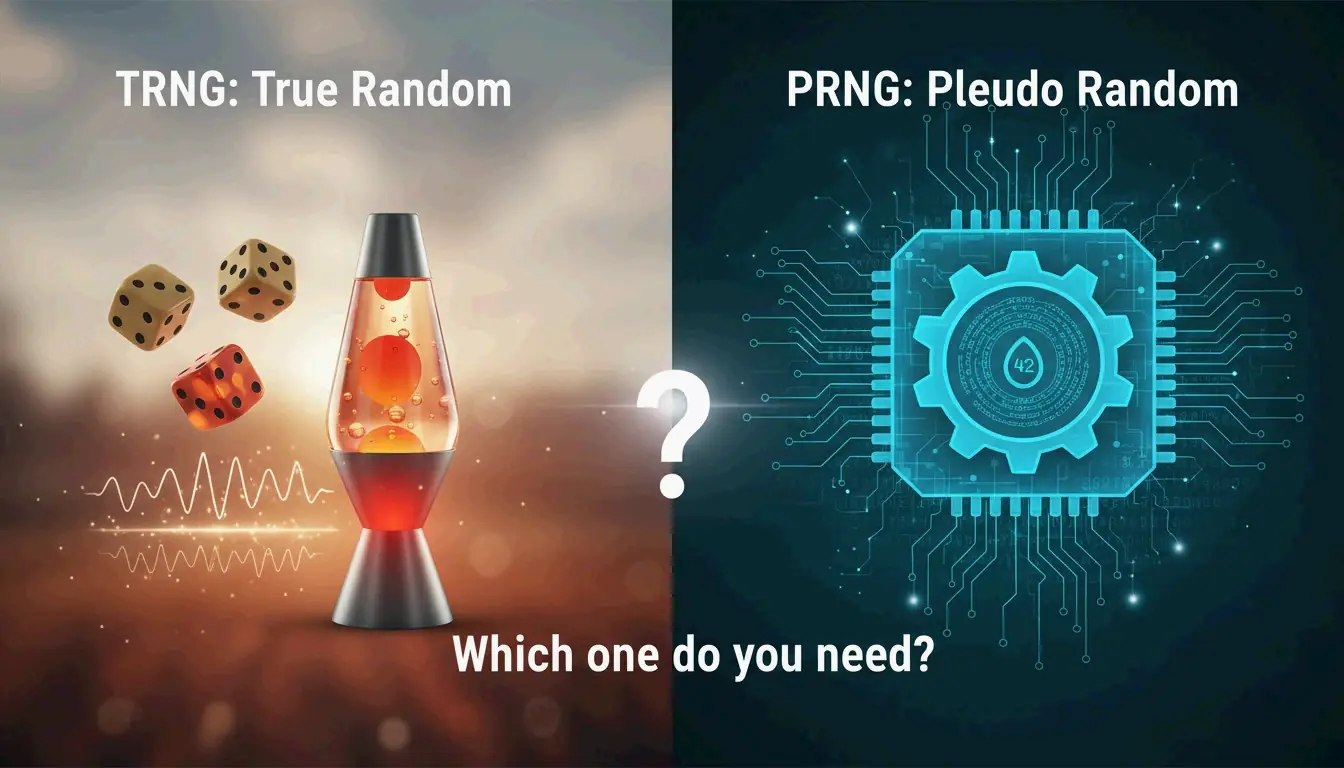
– Generadores de números verdaderamente aleatorios (TRNG): también llamados generadores de números aleatorios por hardware (HRNG): extraen números de fenómenos físicos que son intrínsecamente impredecibles.
– Generadores de números pseudoaleatorios (PRNG): usan algoritmos matemáticos deterministas. Parecen aleatorios, pero son totalmente reproducibles si se conoce el estado inicial (la semilla).
Tener clara esta distinción es el primer paso para mantener seguras tus aplicaciones. Para una visión más amplia de los distintos tipos de herramientas de aleatorización (incluidas las que van más allá de los números), consulta nuestra completa guía del generador de números aleatorios.
El problema central: por qué las computadoras no pueden ser “verdaderamente” aleatorias
Una computadora es una máquina determinista. Cada instrucción sigue una secuencia fija. Para generar un número aleatorio, tiene que depender de una fuente externa de entropía o de un algoritmo que simule la aleatoriedad. Como dijo célebremente el matemático John von Neumann en 1951: “Quienquiera que considere métodos aritméticos para producir dígitos aleatorios se encuentra, por supuesto, en estado de pecado”.
Esa cita, recogida en el artículo de Wikipedia sobre la generación de números aleatorios, encierra una verdad fundamental: los métodos aritméticos (algorítmicos) nunca pueden producir números verdaderamente impredecibles. Solo pueden producir secuencias que parecen aleatorias a las pruebas estadísticas. La única forma de obtener una imprevisibilidad genuina es recolectar entropía del mundo físico: el ruido térmico en una resistencia, el ruido atmosférico, la desintegración radiactiva o incluso los patrones caóticos de las lámparas de lava.
Generador de números verdaderamente aleatorios (TRNG) frente a generador de números pseudoaleatorios (PRNG): la distinción crítica
La diferencia central se reduce a la fuente de imprevisibilidad:
| Característica | TRNG (RNG verdadero) | PRNG (RNG pseudoaleatorio) |
|---|---|---|
| Fuente | Entropía física (ruido térmico, efectos cuánticos, etc.) | Algoritmo matemático |
| ¿Determinista? | No: cada salida depende de un proceso físico | Sí: la misma semilla produce siempre la misma secuencia |
| ¿Reproducible? | No | Sí (si se conoce la semilla) |
| Velocidad | Generalmente más lento, limitado por la recolección de entropía | Muy rápido |
| ¿Bloqueante? | Puede bloquearse si el depósito de entropía se agota | No bloqueante |
| Caso de uso | Criptografía, claves de seguridad, loterías | Simulaciones, juegos, aplicaciones no relacionadas con la seguridad |
Los TRNG miden un fenómeno físico directamente. Las fuentes comunes incluyen el ruido térmico en las resistencias, la fluctuación (jitter) en los circuitos electrónicos, el ruido de disparo en los semiconductores y los fenómenos cuánticos como el efecto fotoeléctrico. Un TRNG práctico suele incluir una fuente de ruido, un digitalizador, un acondicionador (extractor de aleatoriedad) para mejorar la calidad y pruebas de salud para garantizar que la fuente siga funcionando.
Los PRNG parten de un valor inicial llamado semilla aleatoria (a menudo obtenida de un TRNG) y luego aplican repetidamente una transformación matemática para generar el siguiente número. La secuencia es determinista, lo que significa que si conoces la semilla, puedes reproducir exactamente los mismos números. Esta reproducibilidad es excelente para depurar simulaciones, pero desastrosa para la seguridad si un atacante puede descubrir o adivinar la semilla.
Una tercera categoría, los generadores de números pseudoaleatorios criptográficamente seguros (CSPRNG), combina lo mejor de ambos mundos: usan un TRNG para obtener una semilla de alta entropía y luego emplean un algoritmo cuidadosamente diseñado para producir un flujo ilimitado de números computacionalmente indistinguibles de la verdadera aleatoriedad. Los diseños criptográficos estándar adoptan este enfoque híbrido, como se describe en el artículo de Wikipedia.
Cómo los TRNG crean verdadera imprevisibilidad
Los TRNG capturan la aleatoriedad del entorno físico. Un ejemplo famoso lo utiliza Cloudflare: un muro de lámparas de lava en su oficina de San Francisco. Como explica una publicación del blog de Cloudflare (2017), los patrones cambiantes e impredecibles de las lámparas de lava se fotografían y se procesan mediante una función hash para producir números aleatorios de alta entropía. Aunque las lámparas de lava son un enfoque novedoso, la mayoría de los TRNG emplean fuentes más compactas, como el ruido térmico de un diodo polarizado inversamente.
Otro proyecto reciente de aficionados, el Neon Entropy Random Number Generator de Joshua Coleman (mayo de 2026), utiliza tres lámparas de neón vintage. La tasa de descarga de una lámpara de neón energizada varía de forma impredecible, y unos sensores ópticos capturan esa variación. Una Raspberry Pi Pico W lee las señales analógicas y produce valores SHA-256 de 64 bits que pueden usarse como semillas aleatorias. El creador reconoce que el sistema está “mal caracterizado” y necesita validación, pero ilustra el principio de extraer entropía de procesos físicos.
Por qué los PRNG son el caballo de batalla de la informática
Los PRNG están en todas partes porque son rápidos, reproducibles y fáciles de implementar. El artículo de Wikipedia señala que son “centrales en aplicaciones como las simulaciones (p. ej., para el método de Monte Carlo), los juegos electrónicos (p. ej., para la generación procedural) y la criptografía”. En simulación, poder volver a ejecutar la misma secuencia aleatoria partiendo de la misma semilla es crucial para la depuración. En criptografía, un PRNG puede ser seguro, siempre y cuando la semilla se mantenga en secreto.
El PRNG de propósito general más utilizado es el Mersenne Twister (MT19937), conocido por sus excelentes propiedades estadísticas y su largo periodo (2^19937 − 1). Muchos lenguajes de programación (Python, Ruby, PHP) utilizan el Mersenne Twister como generador de números aleatorios predeterminado para fines no criptográficos. Sin embargo, el Mersenne Twister no es criptográficamente seguro: un atacante puede reconstruir su estado interno tras observar unas 624 salidas consecutivas. Para todo lo relacionado con seguridad, necesitas un CSPRNG. Si estás programando en lenguajes específicos, herramientas como el generador de números aleatorios en Python, el generador de números aleatorios en Java y el generador de números aleatorios en C++ te guían por el enfoque correcto para cada plataforma.
Consecuencias reales: cuando los números aleatorios fallan (el caso de manipulación de la lotería)
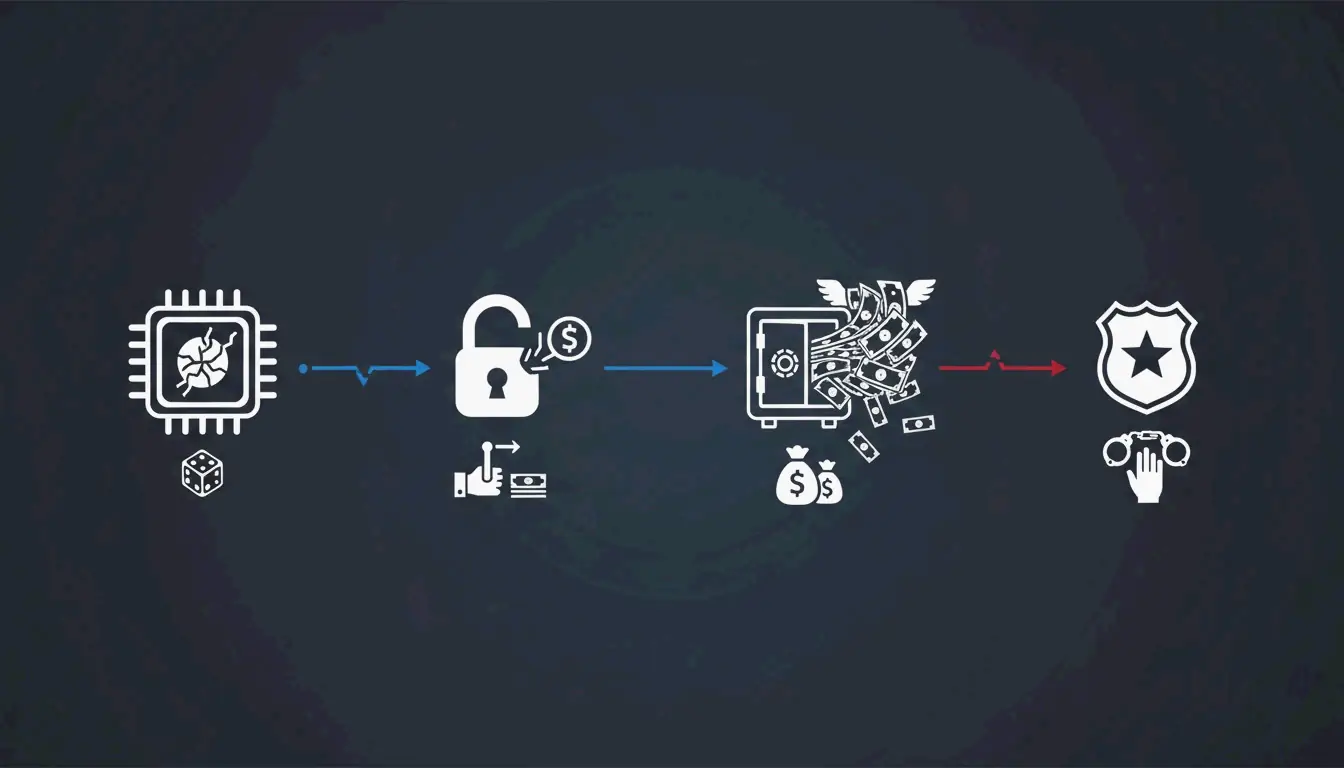
Los resultados de un generador de números aleatorios débil pueden ser catastróficos. El ejemplo más dramático es el caso de manipulación de la lotería de EE. UU. descrito en el artículo de Wikipedia. El director de seguridad de la información de la Multi-State Lottery Association (MUSL) instaló secretamente malware de puerta trasera en la computadora segura del RNG durante un mantenimiento rutinario. A lo largo de varios años, ganó un total de $16.5 million prediciendo los números de la lotería. Este ataque funcionó porque el RNG era efectivamente predecible debido a la puerta trasera: un fallo clásico de depender de un generador comprometido o débil.
Incluso sin puertas traseras maliciosas, una aleatoriedad defectuosa puede causar daños generalizados. El artículo de Wikipedia sobre números aleatorios cita un incidente de 2012 en el que un defecto de aleatoriedad del 99.8 % (no del 100 % completo) en un método de cifrado en línea afectó negativamente a unos 27,000 clientes de un servicio importante. Estos fallos demuestran que incluso pequeñas desviaciones de la verdadera aleatoriedad pueden tener grandes consecuencias.
Otro caso destacado es la puerta trasera de Dual EC DRBG. Este generador de números pseudoaleatorios criptográficamente seguro certificado por NIST fue sospechoso de contener una puerta trasera insertada por la NSA, lo que les permitía (si la teoría es correcta) determinar su estado interno y romper el cifrado que dependía de él. Como señala el artículo de Wikipedia, aunque Dual EC DRBG era “un generador de números pseudoaleatorios muy deficiente y posiblemente con puerta trasera mucho antes de que se confirmara la puerta trasera de la NSA en 2013, había visto un uso significativo en la práctica”, incluido por la empresa de seguridad RSA Security.
En un tono más ligero, la popularidad de las herramientas de números aleatorios en línea muestra cuánto dependen de ellas las personas. Según Wheel of Names, a fecha de 2026 el sitio había registrado 462,479,318 giros de la ruleta y más de 1.28 million horas de giro. El sitio utiliza una función criptográficamente segura (crypto.getRandomValues()) para garantizar una imprevisibilidad genuina para sus usuarios, muchos de los cuales realizan sorteos, selecciones de aula y regalos en directos de streaming. Esta escala de uso demuestra que, cuando un generador de números aleatorios falla, afecta a millones de personas.
Cómo elegir el generador de números aleatorios adecuado para tu caso de uso en 2026
Elegir el generador de números aleatorios adecuado depende de las necesidades de tu aplicación en cuanto a seguridad, velocidad y reproducibilidad. Usa este marco de decisión:
Para criptografía: el uso obligatorio de CSPRNG
Si tu aplicación implica claves de cifrado, tokens de autenticación, identificadores de sesión o cualquier otro dato sensible a la seguridad, debes usar un generador de números pseudoaleatorios criptográficamente seguro (CSPRNG). Nunca uses Math.random(), random.randint() ni el Mersenne Twister para estos fines. Las consecuencias de la previsibilidad (robo financiero, fugas de datos, apropiación de cuentas) son demasiado graves.
Herramientas recomendadas:
– Navegadores web: usa la Web Crypto API (crypto.getRandomValues()). Es lo que usa Wheel of Names para garantizar la aleatoriedad.
– Sistemas Unix/Linux: lee de /dev/urandom. Te ofrece un CSPRNG no bloqueante sembrado con entropía de hardware. (Nota: /dev/random se bloquea hasta que hay suficiente entropía disponible y no se recomienda para lecturas masivas.)
– Windows: usa CryptGenRandom() o RNGCryptoServiceProvider.
– Procesadores Intel: la instrucción RDRAND devuelve números aleatorios de un generador de hardware integrado en el chip, pero muchos sistemas preocupados por la seguridad mezclan su salida con otras fuentes de entropía para defenderse de posibles puertas traseras.
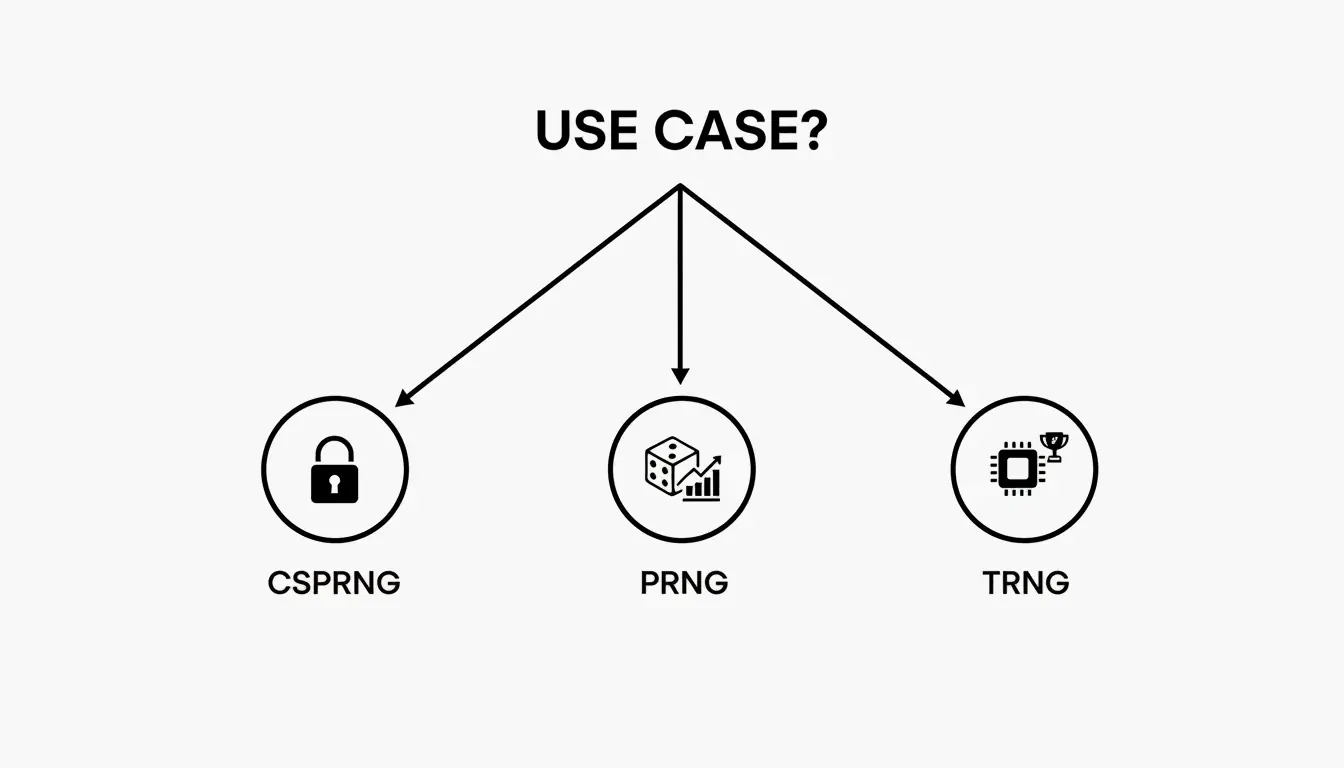
Para simulaciones y juegos: la velocidad de los PRNG (como el Mersenne Twister)
Para simulaciones de Monte Carlo, computación científica, videojuegos y generación procedural de contenido, la velocidad y la calidad estadística importan más que la seguridad criptográfica. Aquí, un PRNG rápido como el Mersenne Twister (MT19937) o la más reciente familia PCG funciona bien. Estos generadores producen miles de millones de números por segundo y superan la mayoría de las pruebas estadísticas.
- Reproducibilidad es una ventaja clave: partir de la misma semilla produce la misma secuencia, algo vital para depurar y garantizar que los experimentos puedan replicarse.
- Precaución: no los uses para nada que implique dinero, identidad o control de acceso.
Para loterías y equidad: la necesidad de entropía basada en hardware
Las loterías, los concursos, los sorteos de premios y cualquier sistema en el que la equidad sea legal o éticamente obligatoria deben usar entropía basada en hardware (TRNG) o, al menos, un CSPRNG bien diseñado sembrado a partir de entropía física. El caso de manipulación de la lotería demuestra que incluso un RNG “seguro” puede verse comprometido si se manipula la semilla o el software. La aleatoriedad física procedente del ruido atmosférico (como Random.org), los generadores de números aleatorios cuánticos o los módulos de hardware dedicados ofrece la mayor garantía de imprevisibilidad.
Para tareas cotidianas como generar un número de teléfono aleatorio para pruebas, un generador de números de teléfono aleatorios ofrece resultados rápidos y fiables sin la complejidad del hardware criptográfico.
Para aplicaciones de alto riesgo:
– Fuentes físicas: usa un HRNG dedicado (p. ej., uno basado en ruido térmico o emisión fotónica cuántica).
– Enfoque híbrido: combina entropía de hardware con un CSPRNG para mayor velocidad.
– Auditoría: prueba regularmente la salida para comprobar uniformidad e independencia (véase la sección 6).
Lo último en aleatoriedad: investigación y herramientas de vanguardia (actualización de 2026)
Aunque la diferencia básica entre TRNG y PRNG está bien establecida, la investigación reciente amplía los límites de velocidad, eficiencia y adaptabilidad. Un estudio destacado de 2026 publicado en Scientific Reports presenta DMARS_WGO (Dual-Mode Adaptive Reinforced Switching Walrus-Gazelle Optimizer), un algoritmo metaheurístico híbrido que utiliza aprendizaje por refuerzo para equilibrar dinámicamente la exploración y la explotación.
Según el artículo DMARS_WGO: a deep reinforcement-driven hybrid metaheuristic for intelligent adaptive optimization, el algoritmo alcanzó el primer puesto en 26 de 29 funciones de referencia del conjunto CEC2017 y el primer puesto en 8 de 12 funciones de CEC2022. Aunque DMARS_WGO es principalmente un algoritmo de optimización (no un RNG de propósito general), muestra cómo el aprendizaje automático puede mejorar la calidad de los procesos de búsqueda aleatoria: un beneficio directo de una mejor aleatoriedad en las simulaciones.
Para los desarrolladores del día a día, la mejor práctica más importante de 2026 es depender de los CSPRNG a nivel de sistema operativo. La instrucción RDRAND de Intel, disponible en las CPU modernas, ofrece un generador de números aleatorios basado en hardware directamente accesible por código. El /dev/urandom del kernel de Linux utiliza ahora un CSPRNG basado en ChaCha20 que es tanto rápido como seguro. La Web Crypto API (crypto.getRandomValues()) se ha convertido en el estándar para la seguridad de JavaScript del lado del cliente.
Cómo las CPU modernas generan números aleatorios (RDRAND y más allá)
Los procesadores modernos de Intel y AMD incluyen un generador de números aleatorios por hardware (HRNG) integrado, accesible mediante la instrucción RDRAND. Este generador emplea fuentes de entropía en el chip, como el ruido térmico en los transistores metal-óxido-semiconductor (MOS), para producir bits aleatorios. Puede proporcionar miles de números aleatorios por segundo.
Sin embargo, dado que el hardware, en teoría, puede manipularse (como muestra el caso de Dual EC DRBG), muchas aplicaciones sensibles a la seguridad no usan RDRAND por sí solo. El artículo de Wikipedia señala que “para la generación de números aleatorios en Linux, se considera inaceptable utilizar el hardware RNG RDRAND de Intel sin mezclar la salida de RDRAND con otras fuentes de entropía”. Esta práctica, denominada “blanqueamiento” (whitening), combina múltiples fuentes independientes para reducir el riesgo de una puerta trasera oculta.
Cómo probar la “aleatoriedad” de tus números
Incluso si usas un RNG bien diseñado, deberías verificar que su salida presente las propiedades estadísticas esperadas. Las dos comprobaciones principales son la equiprobabilidad (cada valor aparece más o menos con la misma frecuencia) y la independencia (no hay patrones predecibles entre valores sucesivos).
Según la página del generador de números aleatorios de PsychicScience.org, puedes probar el método Math.random() de tu navegador generando 100,000 enteros de secuencia abierta dentro de un rango elegido. La página señala que “por azar, las comprobaciones de aleatoriedad indicarán secuencias no aleatorias alrededor de 1 de cada 10 veces”: una tasa de falsos positivos del 10 % es normal.
La prueba Chi-cuadrado explicada de forma sencilla
La prueba estadística más común para la aleatoriedad es la prueba de bondad de ajuste Chi-cuadrado (χ²). Así es como funciona en la práctica:
- Genera una secuencia de N números con tu RNG (p. ej., 1.000 enteros entre 1 y 6).
- Cuenta cuántas veces aparece cada valor.
- Compara estos recuentos observados con los esperados (para una distribución uniforme, cada valor debería aparecer N/6 veces).
- Calcula el estadístico Chi-cuadrado: suma sobre todas las categorías de ((Observado − Esperado)² / Esperado).
- Interpreta: si la probabilidad asociada a este valor de Chi-cuadrado es mayor que 0.10 (el umbral habitual), no hay evidencia de una desviación significativa respecto de la aleatoriedad.
Una segunda prueba de independencia por pares comprueba si la frecuencia de cada par posible de números sucesivos es igual de probable. Por ejemplo, al lanzar un dado, los pares (1,1), (1,2), …, (6,6) deberían aparecer cada uno con una frecuencia similar. Una prueba de tabla de contingencia Chi-cuadrado puede detectar sesgos, como una tendencia a alternar entre valores altos y bajos.
Muchas herramientas en línea, incluida la de PsychicScience.org, ofrecen comprobaciones Chi-cuadrado integradas. Para una validación seria, el NIST Statistical Test Suite (STS) proporciona 15 pruebas diferentes, entre ellas pruebas de frecuencia, rachas y frecuencia por bloques.
Conclusión
Entender la diferencia entre TRNG y PRNG es el primer paso para proteger tus aplicaciones y tomar decisiones fundamentadas. Un TRNG recolecta entropía física; un PRNG usa un algoritmo determinista y una semilla; un CSPRNG combina ambos para mayor seguridad. Las consecuencias reales de elegir el incorrecto pueden ser pérdida financiera, responsabilidad legal y daño reputacional, como muestra el caso de manipulación de la lotería por valor de $16.5 million.
Consejo aplicable: empieza hoy a auditar tu base de código para asegurarte de que Math.random() nunca se utiliza en ningún contexto de seguridad, autenticación o generación de tokens. Migra a CSPRNG para todas las operaciones sensibles. Para simulaciones y juegos, un PRNG rápido como el Mersenne Twister está bien, pero sé siempre consciente del requisito de reproducibilidad. Y si gestionas una lotería, un sorteo o cualquier sistema crítico en términos de equidad, invierte en un RNG de hardware dedicado o en un CSPRNG bien validado con fuentes de entropía auditables. En palabras del estudio DMARS_WGO de 2026, la capacidad de “adaptar inteligentemente su dinámica de búsqueda” es la vanguardia, pero para la mayoría de los desarrolladores, simplemente elegir la herramienta adecuada existente es el paso con mayor impacto.
Preguntas frecuentes
¿Cuál es la diferencia entre un generador de números verdaderamente aleatorios (TRNG) y un generador de números pseudoaleatorios (PRNG)?
Un TRNG utiliza procesos físicos (ruido térmico, efectos cuánticos, lámparas de lava) para generar números intrínsecamente impredecibles. Un PRNG utiliza un algoritmo matemático y una semilla inicial; la salida parece aleatoria, pero es totalmente determinista. Para seguridad, se requiere un TRNG o un CSPRNG.
¿Los números aleatorios generados por sitios web son verdaderamente aleatorios?
La mayoría de los sitios web usan PRNG, que son deterministas pero estadísticamente aleatorios. Los sitios de confianza para criptografía o loterías usan entropía basada en hardware o CSPRNG (p. ej., la Web Crypto API). Para aplicaciones no relacionadas con la seguridad, como selectores de nombres, un PRNG simple suele ser suficiente.
¿Cómo puedo generar números aleatorios criptográficamente seguros?
Usa APIs dedicadas como la Web Crypto API (crypto.getRandomValues()) en los navegadores. En sistemas Unix/Linux, lee de /dev/urandom. Nunca uses Math.random() para fines de seguridad. Para generación masiva, los CSPRNG modernos como ChaCha20 son rápidos y seguros.
Preguntas frecuentes
¿Cuál es la diferencia entre un generador de números verdaderamente aleatorios (TRNG) y un generador de números pseudoaleatorios (PRNG)?
Un TRNG utiliza procesos físicos (ruido térmico, efectos cuánticos, lámparas de lava) para generar números intrínsecamente impredecibles. Un PRNG utiliza un algoritmo matemático y una semilla inicial; la salida parece aleatoria, pero es totalmente determinista. Para seguridad, se requiere un TRNG o un CSPRNG.
¿Los números aleatorios generados por sitios web son verdaderamente aleatorios?
La mayoría de los sitios web usan PRNG, que son deterministas pero estadísticamente aleatorios. Los sitios de confianza para criptografía o loterías usan entropía basada en hardware o CSPRNG (p. ej., la Web Crypto API). Para aplicaciones no relacionadas con la seguridad, como selectores de nombres, un PRNG simple suele ser suficiente.
¿Cómo puedo generar números aleatorios criptográficamente seguros?
Usa APIs dedicadas como la Web Crypto API (crypto.getRandomValues()) en los navegadores. En sistemas Unix/Linux, lee de /dev/urandom. Nunca uses Math.random() para fines de seguridad. Para generación masiva, los CSPRNG modernos como ChaCha20 son rápidos y seguros.
Artículos Relacionados

Generador de Fuentes: El Mapa Completo del Texto con Estilo en 2026
Generador de fuentes estéticas: la guía definitiva para texto Unicode con estilo

Generador de fuentes de caligrafía: herramienta online gratuita para estilos de texto elegantes